Commercial Rainwater Solutions
Rainwater Harvesting for Transport Sites
Railway stations, bus depots and airport terminals share two things most buildings don’t: enormous roofs and relentless, predictable demand. Concourses run toilets from first service to last, depots wash fleets on a fixed daily cycle, and most of that water is still drawn straight from the mains.
Stormsaver has delivered this across the sector, including at the UK’s largest bus depot, where harvested rainwater now meets 71% of demand. This guide covers where rainwater harvesting fits across stations, depots and terminals, and why washing trains, buses and ground vehicles brings a specific compliance requirement under BS EN 16941-1.
Why transport sites are ideal for rainwater harvesting
- Large roof catchments. Train sheds, bus garages, concourses and terminal roofs are among the biggest single catchments in the built environment.
- Demand that matches supply. Transport WCs see use from early morning to last service, and wash bays run on a fixed cycle, so stored rainwater turns over quickly rather than sitting stagnant.
- Three demand profiles in one sector: footfall-driven WC flushing at stations and terminals, fleet and rolling-stock washing at depots, and maintenance wash-down in workshops and aprons.
Transport is a distinct vertical from logistics. Logistics is about private sites and fleet-efficiency for HGVs. Transport is public-facing: passenger footfall, published sustainability commitments from rail and airport operators, and rolling stock washed close to staff and sometimes the public. That difference shapes which system and which safeguards a site needs.
Transportation Case Studies


Where rainwater fits across a transport estate
Railway stations and interchanges
Concourse and platform WCs, cleaning water, landscape irrigation.
Bus stations and depots
Passenger and driver WCs, bus washing, wheel and chassis wash, yard wash-down.
Train maintenance depots
Automatic train wash plants, depot welfare facilities, wash-down of pits and aprons.
Airport terminals and operations buildings
Terminal WCs, ground support equipment washing, irrigation.
Vehicle maintenance facilities
Council fleets, highways depots and similar sites with vehicle wash and workshop wash-down.
All Sites
All of this is non-potable use. Rainwater is never used for drinking, food preparation or personal washing.
Train washing and UV disinfection: what BS EN 16941-1 Requires
Train washing is one of the strongest applications for rainwater harvesting in the sector, and one of the few that comes with a specific technical requirement attached.
Automatic train wash plants use large daily volumes of non-potable water, and the high-pressure arches and spray systems that deliver it create a fine aerosol that drifts across the wash road and surrounding walkways. Rainwater is classed as Category 5 water. Left untreated, bacteria in that aerosol can be inhaled or ingested by depot staff, drivers and anyone else working nearby, and unlike a WC flush, a wash plant generates spray continuously, shift after shift.
Because of this, BS EN 16941-1 requires UV disinfection wherever rainwater produces a fine vapour or aerosol, including vehicle wash-down. The same logic applies to bus washing and pressure-washed wash-down, and to airside vehicle washing at airports.
UV only works on clear water, so it needs to be paired with a third stage of filtration ahead of it, an automatic backwash filter, to prevent suspended particles from shielding bacteria from the UV light, an effect known as shadowing. UV sits downstream of the break or header tank, at the point of supply to the wash plant, and self-circulating UV is available for large header tanks. Lamp replacement and quartz sleeve cleaning are built into routine servicing, and existing depot systems without UV can be retrofitted.
For WC-only systems at stations, UV is good practice rather than a requirement. For any spray application, it needs to be specified.
Choosing the right system
Non-pressurised
Combi
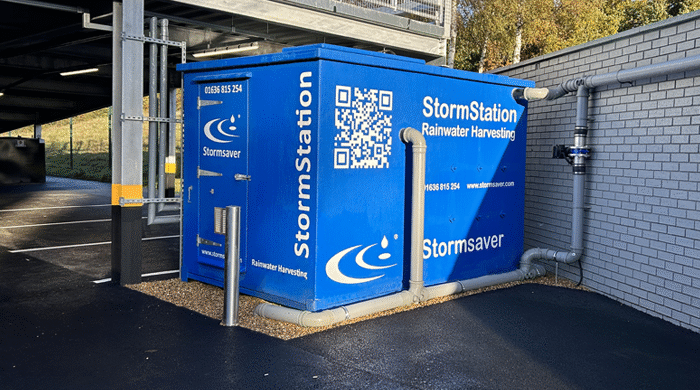
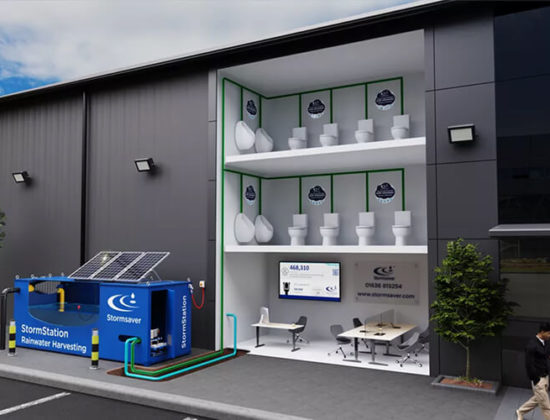
StormStation
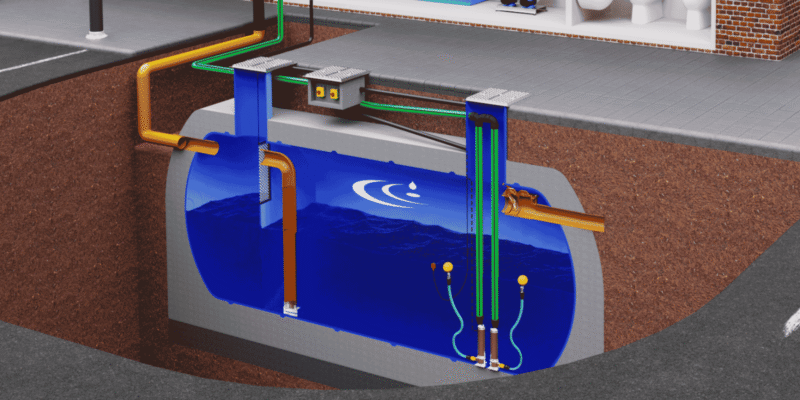
Suits large-scale depots and terminals that need maximum reliability: a central tank boosts to a header or break tank, as used at First Bus Caledonia.
Delivers the same reliability in a smaller footprint, with an integrated break tank and booster set suited to plant rooms with no space for a header tank, as used at Manchester Interchange.
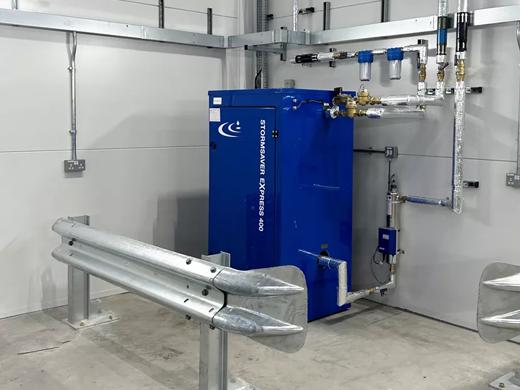
A plug-and-play option for retrofitting station and bus station WC blocks with no civils work required, with UV re-circulation built in as standard. It is not suitable for commercial vehicle or train wash supplies, which need the higher flow rates of a non-pressurised, Combi or Pressurised system.
To size a system correctly, Stormsaver needs the roof area and local rainfall, WC and urinal count and footfall, wash cycles per day and litres per wash, wash-down frequency, and operating days per year.
Non-pressurised
Suits large-scale depots and terminals that need maximum reliability: a central tank boosts to a header or break tank, as used at First Bus Caledonia.
Combi
Delivers the same reliability in a smaller footprint, with an integrated break tank and booster set suited to plant rooms with no space for a header tank, as used at Manchester Interchange.
StormStation
A plug-and-play option for retrofitting station and bus station WC blocks with no civils work required, with UV re-circulation built in as standard. It is not suitable for commercial vehicle or train wash supplies, which need the higher flow rates of a non-pressurised, Combi or Pressurised system.
To size a system correctly, Stormsaver needs the roof area and local rainfall, WC and urinal count and footfall, wash cycles per day and litres per wash, wash-down frequency, and operating days per year.
Airports: large roofs, congested ground
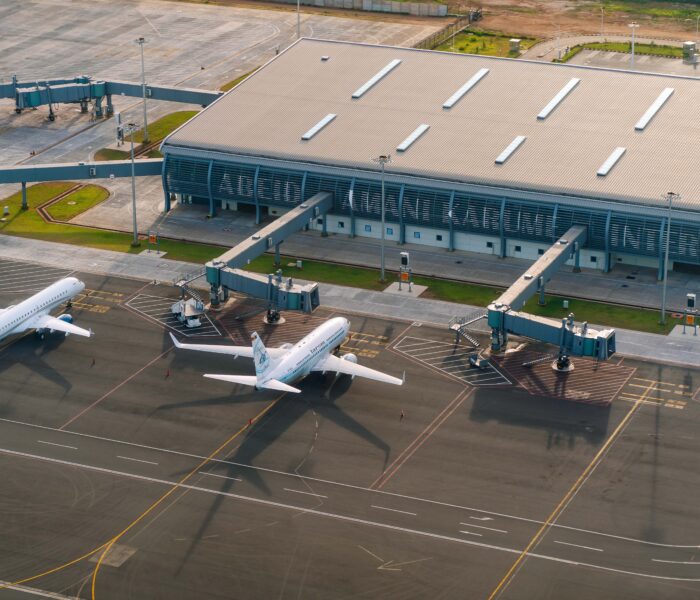
Airport terminal roofs offer some of the best rainwater collection potential of any building type, but the ground beneath them is typically congested with underground services, leaving little room for a large tank.
Two approaches solve this. Smart SuDS and Active Attenuation use the attenuation capacity an airport has to build for planning purposes anyway, reading Met Office forecasts up to 72 hours ahead and guaranteeing 100% of the required attenuation volume while making stored rainwater available for reuse, removing the need for a second tank. Where terminal WC blocks are stacked vertically, Aqualoop greywater recycling complements this by capturing the near-continuous basin water those blocks generate.
Airport operators are already moving in this direction. Gatwick’s Second Decade of Change policy commits to cutting potable water consumption by 50% per passenger by 2030 against a 2019 baseline, and names on-site rainwater reuse for toilet flushing as part of how it plans to get there.
Compliance and sustainability drivers
Every Stormsaver system is designed to BS EN 16941-1:2024, covering sizing, installation and maintenance, and it’s the standard behind the UV requirement for spray applications described above. DEFRA’s National Standards for SuDS, published in June 2025, place rainwater reuse at the top of the runoff-destination hierarchy, meaning new depots, interchanges and terminals need to justify not harvesting rather than the other way round, and the standards are explicit that higher cost alone isn’t sufficient justification to use a lower-priority option. BREEAM Wat 01 rewards new-build and refurbished transport buildings for reducing potable demand, and Part G Building Regulations require non-wholesome supplies to be correctly separated and labelled, with mains top-up through a compliant air gap.
The sector’s own commitments add weight to the case. Network Rail is targeting net zero by 2050, with water sitting outside the current strategy’s core focus, which leaves estates teams room to lead on it independently. Train operators are already watching station water closely: Southeastern has installed over 150 automatic meter readers across its estate, taking readings every 15 minutes, and has used that data to flag unexplained night-time water use in station toilets for action.
Monitoring and maintenance
Every system includes rainwater and mains meters as standard, with BMS connectivity for estates teams managing multiple sites, and an optional monitoring display can turn hidden plant into visible savings data in a concourse or terminal. Servicing twice a year covers UV lamp checks, filters, pumps and valve calibration, with a full tank clean every two to three years, and ground-level-serviceable filters reduce the need for confined space entry. Stormsaver also repairs, upgrades and retrofits UV on existing systems, including those installed by other manufacturers.
Transport FAQs
Does train washing with rainwater need UV disinfection?
Yes. Train washing creates a fine spray and aerosol, and BS EN 16941-1 requires UV disinfection wherever rainwater is used this way, paired with a third stage of filtration to prevent shadowing.
Can rainwater supply a bus wash?
Yes, specified with the same UV and filtration requirement as train washing. A non-pressurised, Combi or Pressurised system is used, not StormStation.
How much can a railway station or bus station save?
It depends on roof area and footfall. A 700 m² roof at a bus station in North Nottinghamshire was designed to save 400,000 litres a year.
Can a system be installed at a live station without disrupting operations?
Yes. Above-ground tanks, as used at Manchester Interchange and North Nottinghamshire, keep concourses and arrivals areas open throughout installation and maintenance.
Can airports combine attenuation and rainwater harvesting?
Yes, through Smart SuDS and Active Attenuation, which uses the attenuation capacity an airport needs for planning anyway.