Everything you need to know
About this guide
Are you seeing an increasing number of commercial rainwater harvesting systems on your projects?
This guide is intended to support Public Health and Civil Engineers by providing practical insights aligned with BS 16941-1, alongside best practice recommendations informed by over two decades of experience in the design, manufacture and operation of commercial water reuse systems.
As demand for water reuse continues to grow, the correct specification of rainwater harvesting systems becomes increasingly important. Well designed systems should include fail safes, controls and maintenance considerations to ensure reliable operations for the long term. End users are becoming increasingly water conscious as we move ever closer to the predicted daily deficit of 5 billion litres by 2055. This is coupled with local planners increasingly adopting the National Standard for SuDs which requires rainwater harvesting as standard.
In this guide, we cover:
- Typical design considerations aligned with the principles of BS 16941-1
- Key system components and their role in overall performance
- Filtration strategies for different site typologies, including a comparative filtration matrix
- A typical approach to sizing commercial rainwater harvesting systems
- A comprehensive frequently asked questions section based on common queries from design engineers
What is BS 16941-1?
The British Standard for rainwater harvesting is BS 16941-1. This standard provides design guidance for the specification, installation, operation and maintenance of rainwater harvesting systems, and is intended for use by designers, manufacturers and maintainers.

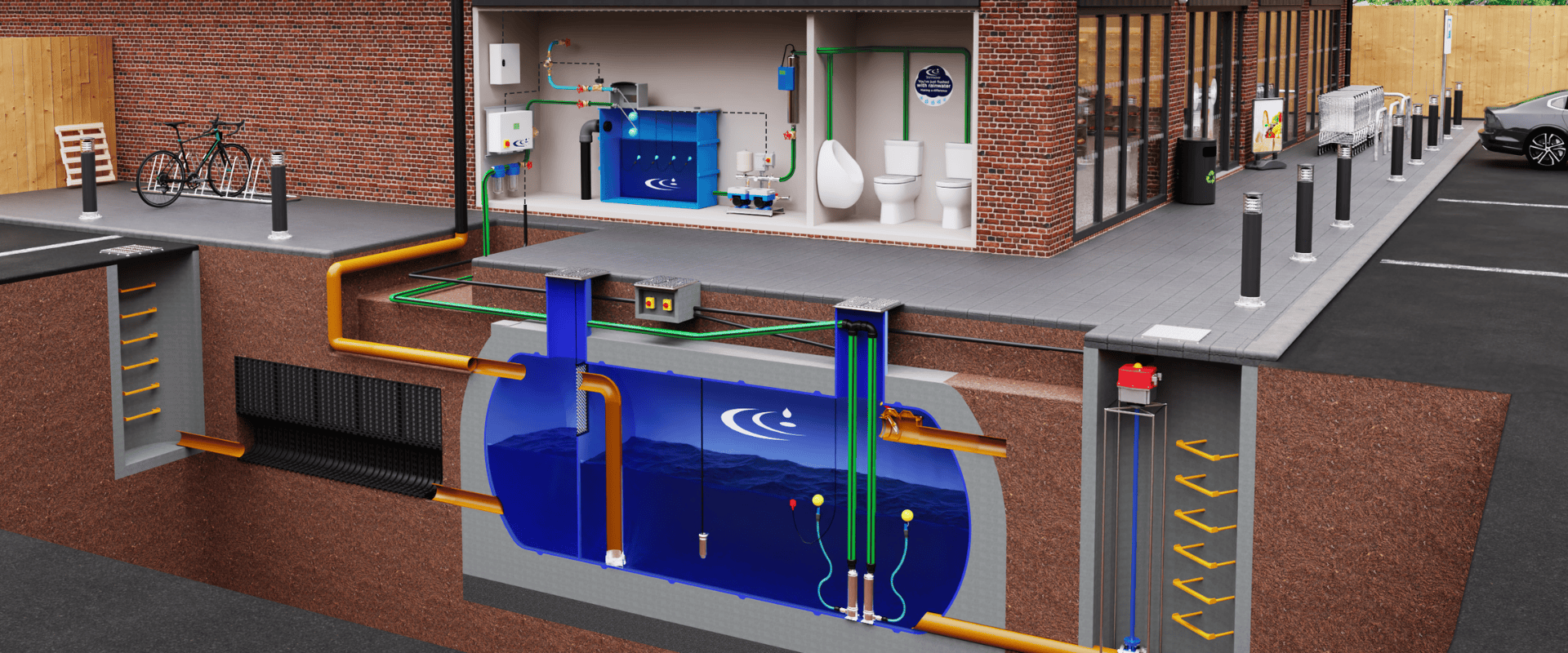
System Components Overview & Explanation
Roof Catchment & Gutters
On commercial rainwater systems, rainwater is captured from the roof area of the building. Large commercial properties are ideal for harvesting rainwater due to their extensive roof areas, which makes collection simple!
Designers commonly connect downpipes to below-ground drainage via sealed gullies. These help prevent external contaminants from entering the storage tank, ensuring water quality is protected.
Pre-Tank Filter
Most systems include a preliminary stage of filtration which should be located before the storage tank. This stage removes larger debris (typically 1 mm or larger) from the incoming rainwater supply, such as leaves and bird feathers. This prevents them from entering the storage tank.
Provision should be made for periodic cleaning of the filter to maintain performance and prevent debris from accumulating.
Storage
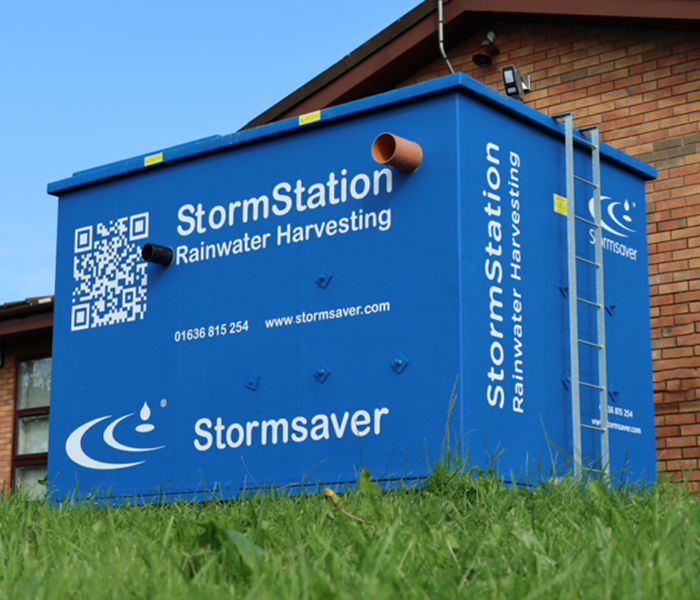
The main storage tank may be installed above or below ground, depending on site space constraints. Where external space is limited, sectional above-ground tanks are often installed in basements, allowing capacity to be built in modular sections to suit the available footprint.
In many commercial settings, below-ground tanks are preferred due to ease of access and minimal space uptake. These design approaches are aligned with the principles of BS 16941-1 for commercial rainwater harvesting.
Break Tank & Mains Top-Up
When water demand is detected within the building, rainwater is boosted into a secondary, smaller tank, commonly known as a break tank. These are typically located in the basement and act as an intermediary storage point.
During prolonged periods of low rainfall, drought, or pump downtime in the main storage tank, mains water can automatically top up the break tank to maintain continuity of supply.
Designers commonly specify systems with break tanks rather than arrangements without them, due to the resilience and reliability benefits they provide. Including a break tank helps ensure that water supply is maintained even if one component of the system fails.
Distribution & Pipework
A variable-speed booster set is usually located adjacent to the break tank to boost rainwater through a dedicated non-potable pipe network within the building.
Pipework should be appropriately labelled in line with WaterRegs UK guidance, ensuring clear separation from potable supplies and supporting safe system operation.

Design considerations aligned with BS 16941-1
1. Mains water protection and uncontrolled top-up
Mains water top-up systems commonly rely on solenoid valves, which can degrade over time and fail partially open. This can lead to mains water continuously entering the tank, increasing overall water consumption and leading to unexpectedly high water bills.
BS 16941-1 places strong emphasis on protecting against uncontrolled mains water top-up events during solenoid valve failures. In practice, commercial systems often incorporate additional safeguards alongside the solenoid valve, such as leak detection or secondary mechanical shut-off devices, to reduce this risk.
2. Mains water top-up pipework turnover
Low water turnover within top-up pipework can result in stagnation and the formation of dead legs. From a water hygiene perspective, this presents an increased legionella risk, particularly where top up demand is relatively low.
To address this, systems designed in line with BS 16941-1 principles commonly include an automatic turnover function. This briefly opens the solenoid valve to release mains water for a short period to promote movement within the pipework and reduce stagnation.
3. Best practice: access for inspection and maintenance
Maintenance access is frequently overlooked at the specification and installation stages, leading to increased servicing costs and avoidable disruption during operation.
Good practice aligned with BS 16941-1 is to ensure all serviceable components are accessible without the need for confined space entry or specialist equipment. Particular attention should be given to storage tank arrangements, with pumps, filters, and components positioned as close to ground level as possible.
4. Best practice: early spatial planning
Rainwater harvesting systems require plant space and are most effective when considered early in the project lifecycle. Early coordination allows system dimensions and spatial allowances to be allocated, reducing design reworks as designs develop.
While BS 16941-1 focuses on system performance and protection, early spatial planning is widely recognised as good practice for achieving compliant and maintainable systems.
5. Best practice: automate where appropriate
Automating routine maintenance and operational functions can significantly reduce manual maintenance intervention and long-term operational costs.
In commercial applications, this often includes automated filter cleaning or backwashing arrangements, which remove the need for frequent manual filter replacement. These approaches can reduce maintenance burden for facilities teams, while supporting improved water quality.
Filtration Practice for Commercial Rainwater Harvesting
Typical BS 16941-1 approach
Commercial rainwater harvesting systems generally include multiple filtration stages to protect system performance and water quality. Commonly, this involves a pre-tank filter to remove coarse debris, and a floating suction filter within the storage tank to minimise sediment intake.
Additional filtration considerations
Depending on site conditions, water use, and exposure levels, further filtration or treatment may be recommended. This can improve water quality, aesthetics or reduce potential health risks.
All Sites (General)
Site Overview
Where harvested rainwater is used for toilet flushing, there is a potential for an aerosol to be created during flushing. Studies indicate that low-flush WC systems can generate aerosols with a vertical rise of 10–100 cm above the bowl.
Potential Operational Impacts
- Microbiological considerations: Rainwater may contain bacteria and other microorganisms. During flushing, these organisms may be dispersed within the immediate toilet environment, presenting a potential risk.
Design and Treatment Recommendations
- Ultraviolet (UV) disinfection: Installation of UV disinfection is recommended to reduce microbiological risk associated with rainwater reuse. UV systems designed and operated correctly are capable of achieving up to 99.99% inactivation of bacteria and are widely considered an effective control measure for water hygiene.
- Pre-UV filtration: Where UV disinfection is provided, upstream filtration is strongly recommended to enhance system performance. An automatic backwash filter with a filtration rating of 35 microns should be installed to reduce suspended solids and minimise UV shadowing, whereby particles shield microorganisms from the UV light and, as a result, reduces disinfection rates. The automatic backwash filter shall be located prior to the break tank on the rainwater pipework only. This is because mains water in the top up function is already filtered to a high-quality level.
Sites Located Near Forested Areas
Site Overview
Commercial rainwater harvesting systems installed in close proximity to forested or heavily vegetated areas are subject to increased organic debris loading due to seasonal leaf fall.
Potential Operational Impacts
- Elevated debris and airborne solids may result in more frequent blockages of the pre-tank filtration, increasing the requirement for manual inspection, cleaning and maintenance.
- Leaf tannins and organic matter may cause slight discolouration of stored rainwater which may be visible in non-potable outlets served by the system. Leaf tannins occurs when natural materials found in leaves come into contact with water.
Design and Treatment Recommendations
- Leaf Guards:
Installation of leaf guards on the guttering system is strongly recommended to minimise the ingress of leaves and organic debris into the pre-tank filtration stage. This measure significantly reduces filter loading and maintenance requirements. - Activated Carbon Filtration:
Activated carbon filtration can be installed post-storage and prior to distribution to remove discolouration caused by organic matter. This treatment option is recommended where water clarity and aesthetic quality of the non-potable supply are a client priority.
Urban Sites
Site Overview
Commercial rainwater harvesting systems installed in high-traffic urban environments are subject to increased volumes of airborne particles. Traffic movements generate fine dust through tire wear and brake wear. Wind can transport these particles upwards, resulting in them landing on roof areas.
While these contaminants are extremely low risk in non-potable applications, their presence could have implications for system reliability and long-term operation.
Potential Contaminants and Operational Impacts
- Urban roof dust: May contain metals such as zinc (associated with tire wear) and copper (associated with brake pad wear).
- Public health considerations: Concentrations are low and pose minimal risk for non-potable uses.
- Operational impacts: Accumulation of fine sediment can lead to filter clogging, increased maintenance frequency, premature wear of pumps and valves – and reduced water savings as a result.
Design and Treatment Recommendations
- Automatic Backwash Filtration: It is strongly recommended that commercial systems in urban environments incorporate an automatic backwash filtration system capable of removing particles to 35 microns. This level of filtration effectively limits sediment levels in downstream components while supporting healthy system operation.
- Activated Carbon Filtration: For sites requiring an extra layer of protection, there are opportunities to further improve water quality through Activated Carbon Filtration to reduce dissolved organic matter. In our experience, this is would be considered a “belt and braces” add-on and is generally not required in most situations.
Sites Collecting from Green Roofs
Site Overview
Biodiversity Net Gain and a growing focus on sustainability mean many developments now include green infrastructure. Green roofs are a key part of this approach and are becoming more common across sites.
Rainwater can be collected from green roofs, and this is already done successfully on many projects. However, compared to conventional roofs, green roofs require additional consideration, particularly around filtration and water quality.
Potential Operational Impacts
- Increased sediment loading:
Green roofs typically generate more sediment than standard commercial roof surfaces. Sediment levels are usually highest during the first 6–12 months of operation. As the green roof system matures, sediment loading generally reduces over time. - Discolouration:
Organic materials within green roofs can release tannins, which may cause a brown discolouration in non-potable water supplies. This does not present a public health risk but may be undesirable from an appearance perspective.
Design and Treatment Recommendations
- Automatic backwash filtration:
Automatic backwash filters reduce fine sediment in the rainwater supply, helping to prevent sediment build-up and reducing the risk of component failure. Filters should be capable of filtering down to 35 microns or below. They should be installed on the rainwater pipework before the rainwater harvesting break tank. - AND Activated Carbon Filtration:
In addition to automatic backwash filtration, activated carbon filters should be used to address tannins from organic matter. This treatment reduces water discolouration in non-potable supplies and should be installed prior to distribution of rainwater around the building.
Sizing Example
BS 16941-1 provides a methodology for sizing commercial rainwater harvesting systems. The following example demonstrates how designers typically interpret the principles of the standard in practice.
This example below looks at a typical, standalone rainwater harvesting system. Where smart SUDS systems or integrated attenuation storage are incorporated, alternative sizing strategies are often applied.
Our experienced sizing specialists can support you with full system sizing.
Site Example: Large distribution centre
Typical Sizing Approach
Designers commonly consider both potential rainwater yield and non-potable demand to calculate storage volumes, using methods aligned with BS 16941-1.
These two calculations are then compared. In most commercial scenarios, the lower of the two volumes is selected to help avoid unnecessary oversizing while maintaining system efficiency.
Demand-Based Assessment (Illustrative Example)
For this example distribution centre, toilet flushing demand is estimated based on assumed building occupancy and typical usage patterns.
Assumptions include:
-
Approximate occupancy of 250 people
-
Modern low-flush WC volumes
-
Limited daily usage per occupant
-
A short storage duration reflecting intermittent demand
Based on these assumptions, the indicative rainwater storage requirement is:
Approximate storage volume: 40,500 litres
This value represents a demand-led estimate intended for comparative sizing only.
Adopted indicative storage volume:
40,500 litres
Yield-Based Assessment (Illustrative Example)
Rainwater yield is estimated using the effective roof catchment area and typical long-term rainfall data for the site location.
Allowances are made for:
-
Runoff losses
-
Filtration losses
-
Seasonal rainfall variability
-
The proportion of annual rainfall that can realistically be harvested and used
Using these assumptions, the indicative annual yield significantly exceeds the demand-led storage volume.
Approximate yield-based volume: 1.77 million litres
FAQs
Got a Question?
What access requirements should I consider?
Maintenance and aftercare are critical when designing commercial rainwater harvesting systems. Ensuring appropriate access at all key points reduces long-term costs and keeps the system operating efficiently.
Control unit
The control panel should be installed with sufficient clearance to allow maintenance technicians to work safely and efficiently. Designers commonly provide around 1 m² of unobstructed space around the panel to allow access for inspection and routine maintenance.
Above ground storage tanks
Above ground tanks should be designed with safe access in mind. This typically includes access ladders and rails to provide fall protection for maintenance personnel. Routine cleaning, inspection and monitoring often require safe access to the top of the tank. Internal tanks that are still above ground should follow the same principles.
Basement or below-ground storage tanks
Basement tanks require consideration for sediment management over time. Periodic cleaning is necessary to prevent sediment accumulation, and in some cases, a gully sucker may be required to remove sediment. Designers should account for the maximum reach of maintenance equipment – for example, standard gully suckers can access up to approximately 15 m from an external entry point – when planning tank location and access.
How do I size a commercial system that integrates with Smart SuDS?
How do I size a commercial system that integrates with Smart SuDS?
When a commercial rainwater harvesting system is integrated with Smart SuDS or attenuation storage, a different sizing approach is typically required. In these arrangements, the storage volume often needs to balance water reuse demand, flood resilience objectives, and site-specific discharge rates.
Rather than sizing solely around rainwater demand or yield, integrated systems are commonly assessed using combined criteria that consider rainfall events and attenuation performance. As a result, tank volumes can differ significantly from those used for standalone rainwater harvesting systems.
What pipework materials are typically recommended?
Pipework within the storage tank
For pipework installed within the storage tank, particularly connections between submersible pumps, floating suction assemblies, and below-ground drainage, robust materials are essential. In practice, MDPE pipework is commonly used due to its durability and resilience during routine servicing, cleaning and pump removal.
Internal distribution pipework
Within the building, copper pipework is often selected for non-potable water distribution. All internal pipework should be clearly identified and appropriately insulated to distinguish it from potable water systems. Labelling and colour identification should follow recognised industry guidance, such as WaterRegsUK recommendations.
What pipework access should be considered?
Adequate access to pipework is essential for safe and cost-effective maintenance of commercial rainwater harvesting systems.
Pipework serving submersible pumps is typically positioned close to finished ground level to allow inspection and cleaning without specialist equipment. In many commercial designs, access is provided within approximately 300 mm of finished ground level.
Where pipework is installed at greater depths, maintenance may require additional operatives and confined-space safety measures, significantly increasing ongoing service costs. Similar access considerations apply to pre-tank filtration components, which should be located where routine inspection and cleaning can be carried out safely and efficiently.
Where can I purchase BS 16941-1?
The full BS 16941-1 standard is available for purchase directly from the British Standards Institution (BSI) via their official website.
What is the lifespan of a commercial rainwater harvesting system?
The operational lifespan of a commercial rainwater harvesting system is primarily influenced by design quality, component selection, installation standards and ongoing maintenance. Systems that are correctly designed and regularly maintained will typically achieve a longer service life than those that are not.
In most commercial applications, mechanical and electrical components such as pumps, control panels and valves can be expected to operate for approximately 15 to 20 years. Service life will vary depending on water quality and usage intensity. Smaller components subject to wear may require replacement at shorter intervals.
Storage tanks and other structural elements generally have a longer service life and can remain operational well beyond this period when correctly specified and installed.
Commercial systems are typically supplied with a 12-month warranty. Extended warranties may be available and can be considered where systems are critical to building operation or subject to higher levels of use.
What can be monitored on a commercial rainwater harvesting system?
Commercial rainwater harvesting systems can be monitored either through a Building Management System or via a dedicated online monitoring portal. Monitoring allows system performance to be reviewed, faults to be identified early and maintenance activity to be planned more effectively.
Typical parameters that can be monitored include:
- Filter condition and maintenance status
- Pump operation and fault or trip conditions
- Water meter data including harvested water usage and mains top up volumes
- UV disinfection operational status where installed
- Valve position and actuation status
- Water temperature within the system
Is there a separate British Standard for greywater recycling?
Yes. Greywater recycling is covered under a separate British Standard, BS 16941-2.
For clarity, greywater recycling refers to the collection and treatment of wastewater from sources such as showers, hand wash basins, and bath tubs for reuse in suitable non potable applications.
What fail safes should be considered?
When designing a commercial rainwater harvesting system, it is important to consider how the system will respond under fault or abnormal operating conditions. Appropriate fail safes help protect building operation, limit disruption and maintain continuity of non-potable water supply where required.
Key considerations include:
- How the system responds in the event of component failure such as pumps, valves, sensors or control equipment.
- Whether the non-potable water supply is critical to building operation and, if so, what measures are in place to maintain service during faults or maintenance activities.
- The level of communication between system controls and all associated components to ensure faults are detected, reported, and managed correctly.
Designing with these considerations in mind supports system resilience and helps ensure reliable operation throughout the system lifecycle. If any of these considerations are present, we recommend speaking with our experts who can advise further.
What if the site has siphonic drainage?
Where a commercial property incorporates siphonic roof drainage, the siphonic action should be broken before rainwater enters a rainwater harvesting system. This is typically achieved by incorporating a drainage bypass arrangement that allows excess rainfall to pass around the rainwater storage tank.
This approach is required because the high flow rates and negative pressures generated within siphonic drainage systems are not compatible with rainwater harvesting equipment and can adversely affect filtration components, storage tanks, and internal pipework.
Early coordination between the rainwater harvesting design and the roof drainage strategy is essential. Where siphonic drainage is proposed, specialist advice should be sought to ensure the systems are correctly integrated.
How do I calculate tank size when there are multiple roof types?
When a rainwater harvesting system collects from multiple roof areas, a more detailed approach to estimating total yield is recommended. Each roof area should be considered individually, considering its surface area and the characteristics of its material, which influence runoff efficiency.
Indicative runoff coefficients can be used to reflect differences in roof material and slope, and the potential contribution from each area is calculated separately. These individual contributions are then combined to provide an overall estimate of the rainwater storage volume required for the system.
This method allows designers to account for the variability in rainfall collection across different roof types and helps ensure the system is neither undersized nor excessively large.
This would be the best approach to aligning with BS 16941-1.
Do storage tanks have an overflow?
Yes. Commercial rainwater harvesting systems typically incorporate an overflow arrangement to manage excess water once the storage tank reaches capacity.
Systems designed in line with the principles of BS 16941-1 commonly include an internal overflow connection that discharges surplus water away from the tank. This is usually directed to a suitable drainage system or infiltration arrangement, depending on site constraints. Allowing periodic overflow also supports water turnover within the tank and helps reduce the risk of long term stagnation.
Rainwater harvesting tanks also include an inlet connection, which is the point at which collected rainwater enters the tank. The size, orientation, and configuration of both the inlet and overflow can be adapted to suit site specific drainage requirements and hydraulic conditions.
To protect the system and surrounding drainage infrastructure, overflow connections are typically fitted with backflow protection, such as a non return valve, to prevent reverse flow into the storage tank.
How often should the mains water top up turnover operate?
The turnover function within a commercial rainwater harvesting system is intended to reduce the risk of stagnation within the mains water top up pipework where usage is low.
In many commercial designs, an automatic turnover function is incorporated to periodically introduce a small volume of mains water into the system. This promotes movement within the top up pipework and reduces the potential for dead legs to form.
A commonly adopted approach is for the turnover function to operate approximately once every 24 hours for a short duration. This balances the need for water movement with the objective of minimising unnecessary mains water consumption while supporting public health protection.
Is a break tank always necessary?
While a break tank is not mandatory, it is strongly recommended in most commercial rainwater harvesting installations. Based on extensive experience of system operation, aftercare, and maintenance, incorporating a break tank sized to accommodate a period of sustained peak demand significantly improves system resilience and operational reliability.
Systems designed without a break tank are typically less water efficient and carry a higher risk of interruption to non potable water supply during component failure or maintenance activities.
Where a break tank is provided, any interruption to the rainwater supply results in the mains water automatically topping up the break tank. This allows continued supply to non potable outlets even if the primary rainwater storage, pumps, or controls are unavailable.
In contrast, systems without a break tank often rely on mains water topping up directly into the main rainwater storage tank. If a failure occurs within this part of the system, neither rainwater nor mains water may be able to reach the points of use, resulting in loss of service.
Enjoyed this guide? Learn more
Summary
If you would like to learn more about commercial rainwater harvesting, greywater recycling or water reuse, then we would encourage you to book onto one of our Free CPD courses. These fully accredited sessions are designed specifically for Public Health and Civils Engineers to provide best practice advice and compliance information.