Designed for Flood Engineers
About this Guide
Are you an engineer working within a Lead Local Flood Authority?
Then this guide has been written for you.
Drainage design has reached a turning point. The introduction of the long-awaited National Standards for SuDS has raised the bar, placing greater emphasis on non-potable water systems and rainwater harvesting. As a result, interest in water reuse has never been higher.
Recognising the need for water reuse, the Minister of Housing, Communities and Local Government committed, through the Revised Environmental Improvement Plan, to upskilling LLFAs on water reuse systems, including commercial rainwater harvesting. LLFAs now sit firmly at the centre of how these systems are assessed, approved and delivered.
At Stormsaver, we are passionate about sharing our knowledge and bring decades of hands-on experience in the design, manufacture and long-term maintenance of commercial rainwater harvesting systems. We’ve seen what works, what fails, and what stands up in the real-world. This guide shares that experience through clear, practical insights.
What we will cover in this guide…
- Key points within the National Standards for SuDS relating to rainwater harvesting
- The purpose and role of rainwater harvesting within the wider drainage context
- Commercial rainwater harvesting systems and how different systems operate
- Sizing considerations and design drivers
- Fail-safe features and resilience measures
- Maintenance requirements and long-term management

Overview
The National Standards for SuDS & Commercial Rainwater Harvesting
While the National Standard for SuDS is currently non-statutory (it is not legislation), many local authorities are already adopting the standard through their local plans. Where already adopted, the standard is expected to be applied in full and will increasingly shape how planning applications are assessed.
Commercial rainwater harvesting plays a central role within the new standard, particularly in the section on standard runoff destinations. This section sets out how surface water should be managed and establishes a clear hierarchy of preference. Importantly, rainwater harvesting is identified as the first priority, reinforcing its importance as drainage method.
The key points relating to rainwater harvesting are summarised below.

What You Need to Know
Key Clauses Relevant to Rainwater Harvesting
Clause 1.11
Rainwater harvesting must be considered in all circumstances, particularly where:
- There is a demand for non-potable water
- A suitable catchment area is available
- Irrigation is required
- The development is located within a seriously water-stressed area
Clause 2.7
Rainwater harvesting systems should be sized in accordance with BS 16941-1. The standard makes a clear distinction between water butts and rainwater harvesting systems. Water butts are not considered compliant as they cannot guarantee available storage, whereas full systems can.
Clause 7.10
All SuDS assets, including rainwater harvesting systems, must be supported by a management and maintenance regime. This should clearly define:
- Inspection and maintenance frequencies
- Responsibility for maintenance
- Locations where sediment removal is required and how often
- Required remedial actions under different operational scenarios
Essential Knowledge for LLFAs
Commercial Systems Overview
There are two approaches for achieving commercial rainwater harvesting that can be used to manage and reuse rainwater effectively. The sections below provide an overview of each approach and explain their purpose and role within the wider drainage strategy.
Standalone Rainwater Harvesting System
Purpose:
To harvest and store rainwater for non-potable reuse on site.
Role within the wider drainage strategy:
Within the wider drainage strategy, the rainwater harvesting system captures rainfall and stores it for non-potable reuse. Any rainfall that exceeds the available storage capacity will discharge via an overflow and must be managed separately as part of the site’s surface water strategy.
What this means:
In this configuration, the rainwater harvesting system operates independently from the site’s SuDS infrastructure and does not contribute to attenuation requirements.
Smart SuDS Rainwater Harvesting System
Purpose:
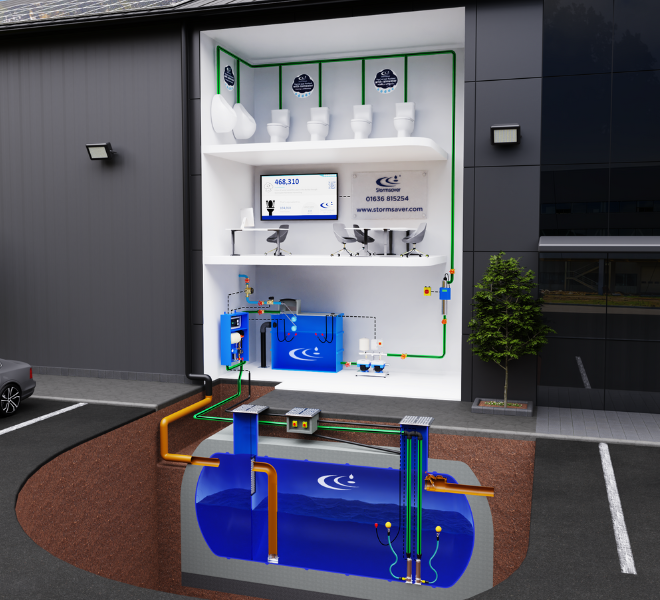
A dual-purpose system designed to provide surface water attenuation while also storing rainwater for non-potable reuse, achieved through dynamic storage level management.
Role within the wider drainage strategy:
Within the wider drainage strategy, the Smart SuDS rainwater harvesting system captures rainfall and stores it for non-potable reuse. The system actively manages storage capacity in response to forecast and real-time rainfall, allowing it to safely attenuate site runoff in accordance with the drainage design, while maintaining suitable volumes of water for reuse.
What this means:
In this configuration, the rainwater harvesting system forms an integral part of the site’s SuDS infrastructure rather than operating as a standalone reuse measure.

Commercial Systems
Sizing Methods & Considerations
Standalone Rainwater Harvesting Systems
Smart SuDS Rainwater Harvesting Systems
Standalone commercial rainwater harvesting systems are sized in accordance with BS 16941-1: Rainwater Harvesting Systems. The standard requires two separate calculations to be undertaken, with the smaller of the two results adopted as the final tank size.
Yield calculation – assesses how much rainwater can be collected:
- Runoff coefficient (typically 80% for commercial roofs)
- Filter coefficient (typically 90%)
- Local annual rainfall (mm)
- Collecting roof area (m²)
Demand calculation – assesses the non-potable water demand:
- Number of outlets supplied with rainwater
- Volume of water used per demand event
- Occupancy levels – to determine outlet usage
Smart SuDS rainwater harvesting systems are sized differently to standalone commercial systems. These systems typically comprise of two storage components, a rainwater harvesting tank and attenuation crates, which together provide the required storage capacity.
Sizing is undertaken using the following approach:
- Calculate the total site attenuation volume required.
- Separate the required attenuation volume for roof runoff from that required from other impermeable areas.
- Assign the roof runoff attenuation volume to be managed by the Smart SuDS rainwater harvesting system.
- Allocate 18,500 litres of the roof attenuation volume to a small rainwater harvesting tank, which houses the submersible pumps and pre-tank filtration components. This represents the minimum tank size required to house the necessary equipment and connections.
- Allocate the remaining roof attenuation volume to attenuation crates. The tank and crates will collectively form a part of the Smart SuDs rainwater harvesting system which manages roof runoff. They will be connected together via pipework.
Standalone Rainwater Harvesting Systems
Standalone commercial rainwater harvesting systems are sized in accordance with BS 16941-1: Rainwater Harvesting Systems. The standard requires two separate calculations to be undertaken, with the smaller of the two results adopted as the final tank size.
Yield calculation – assesses how much rainwater can be collected:
- Runoff coefficient (typically 80% for commercial roofs)
- Filter coefficient (typically 90%)
- Local annual rainfall (mm)
- Collecting roof area (m²)
Demand calculation – assesses the non-potable water demand:
- Number of outlets supplied with rainwater
- Volume of water used per demand event
- Occupancy levels – to determine outlet usage
Smart SuDS Rainwater Harvesting Systems
Smart SuDS rainwater harvesting systems are sized differently to standalone commercial systems. These systems typically comprise of two storage components, a rainwater harvesting tank and attenuation crates, which together provide the required storage capacity.
Sizing is undertaken using the following approach:
- Calculate the total site attenuation volume required.
- Separate the required attenuation volume for roof runoff from that required from other impermeable areas.
- Assign the roof runoff attenuation volume to be managed by the Smart SuDS rainwater harvesting system.
- Allocate 18,500 litres of the roof attenuation volume to a small rainwater harvesting tank, which houses the submersible pumps and pre-tank filtration components. This represents the minimum tank size required to house the necessary equipment and connections.
- Allocate the remaining roof attenuation volume to attenuation crates. The tank and crates will collectively form a part of the Smart SuDs rainwater harvesting system which manages roof runoff. They will be connected together via pipework.
FAQs
Got a Question?
Can rainwater harvesting deal with ‘first flush’ to protect water quality?
Yes. Rainwater harvesting systems can contribute to first flush management in accordance with the National Standards for Sustainable Drainage, Section 2.7.
The National Standards recognise that rainwater harvesting systems can account for:
-
up to 80% of first flush volumes during summer rainfall events, and
-
up to 50% of first flush volumes during winter rainfall events.
This reflects the typically higher rainfall during winter, which reduces the proportion of initial runoff that can be captured and retained.
Where rainwater harvesting is proposed as part of the drainage strategy, its contribution to first flush management should be clearly stated.
What fail-safes are in place on Smart SuDS systems?
Smart SuDS rainwater harvesting systems are designed so that no single failure can compromise flood risk management. In all failure scenarios, the system defaults to a safe, passive attenuation system. The level of stored water within Smart SuDs Systems can either be controlled via a valve or pump (should the drainage level be higher than the storage area).
Component failure scenarios
In the event of failure of any system component, including the control panel, the system will default to a fail-safe state. The control valve that regulates stored water levels will fail open, allowing the system to operate as a typical attenuation system. Stored water will then discharge at the pre-agreed restricted flow rate in accordance with the drainage design.
Communication failure scenarios
To maintain resilience, the control panel maintains continuous communication with Met Office weather forecasting software. A “handshake” check is carried out every five minutes to confirm communication integrity.
If this communication check fails for any reason, the system automatically enters a fail-safe mode. The control valve opens and the system drains down at the specified discharge rate, ensuring attenuation performance is maintained without reliance on active control or forecasting inputs.
Consideration for Pumped Arrangements
If the site relies on pumping equipment to control the level of stored water within the Smart SuDS system, additional protections should be implemented to safeguard the site against flooding. This should include a back-up power supply for the pumping equipment to ensure continued operation in the event of a power failure.
Manual Override
At any time, the Smart SuDS system can be manually overridden and drained as required. This can be carried out remotely via the online portal.
What maintenance regime is proposed for filters, pumps and control systems?
Filters, pumps and control systems should be inspected at six-monthly intervals. Due to the system’s dual role in providing a continuous non-potable water supply (e.g. WC flushing) and contributing to flood risk management, the system should be treated as operationally critical infrastructure.
This requirement should be clearly communicated to the end user, with an appropriate planned preventative maintenance (PPM) schedule in place.
In addition, the system should receive a full clean every two years to prevent sediment build-up and to ensure that the full design storage capacity remains available.
Can the system be adapted or expanded if future rainfall patterns change?
Yes. As climate change places increasing pressure on existing drainage infrastructure, developments that incorporate rainwater harvesting systems have the potential to provide additional storage capacity in the future.
Additional storage can typically be achieved through the retrofitting of above-ground or below-ground storage connected to the existing system. Crucially, where a building has been designed with the required dual pipework to supply non-potable water, this expansion can be undertaken without significant disruption.
Where dual pipework has not been installed, retrofitting a rainwater harvesting system would be considerably more complex and costly.