Commercial Rainwater Solutions
Rainwater Harvesting for Schools, Universities & Colleges
Education buildings put a large roof and a heavy, continuous demand for water in the same place, hundreds or thousands of pupils and students flushing toilets throughout the school day, every term. That combination makes campuses some of the strongest candidates for commercial rainwater harvesting anywhere in the commercial sector and it’s why so many new-build and refurbished education projects now specify it as standard.
Getting it right takes more than a standard commercial system, though. Term-time reliability is non-negotiable, water quality has to be protected for a building full of children or young adults and the system itself becomes part of the site’s sustainability story. Stormsaver has been designing, manufacturing and maintaining water reuse systems for UK education sites for over 20 years, from primary schools to university campuses.
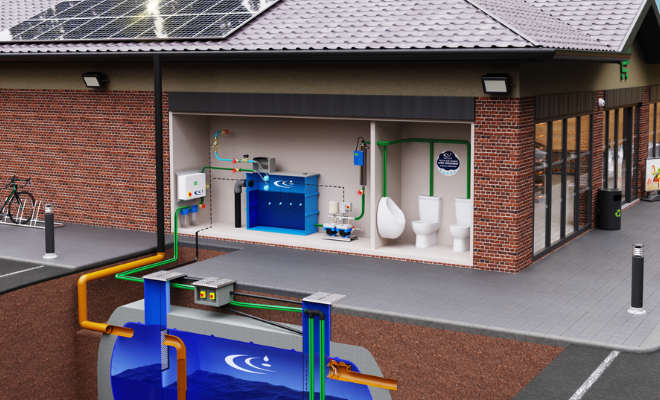
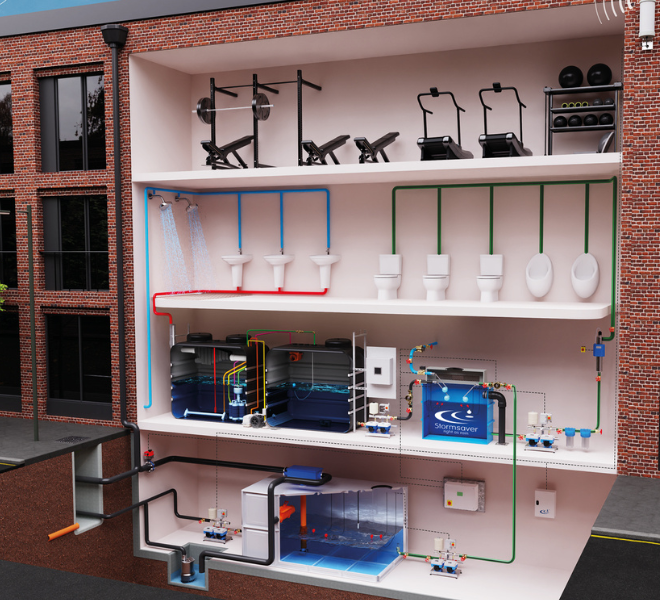
Why education sites are ideal for rainwater harvesting
- Large roof areas. School, college and university buildings typically offer substantial roof catchments. A well-designed system can capture up to around 80% of the rainfall that lands on them.
- High, continuous demand. Toilets and urinals are in near-constant use throughout the school or teaching day and that demand doesn’t need mains-quality water to meet it.
- No behavioural change required. Switching WC flushing to rainwater doesn’t ask staff, pupils or students to do anything differently, the savings happen automatically.
- A wide range of applications. Beyond WCs and urinals, harvested rainwater on campus can serve sports-pitch and grounds irrigation and fleet or minibus washing.
Across more than 2,500 client sites, Stormsaver typically meets up to 75% of a building’s non-potable demand with harvested rainwater.
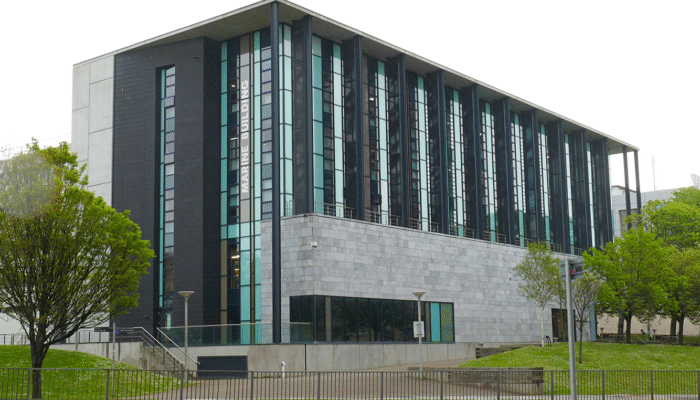
Educational Case Studies

What makes an educational system different
Combi or non-pressurised: matching the system to the site
Redundancy: because washrooms can't go out of service in term time
An educational tool as well as a water-saving one
UV disinfection and the filtration stage it depends on
Most schools, colleges and universities are specified with either a Combi or a non-pressurised system.
Combi is Stormsaver’s most-specified commercial product and the right fit for the majority of education buildings: a hybrid system that combines the reliability of a header-tank design with the pressurised delivery of a boosted system, housed in a pre-wired, pre-tested unit with an internal buffer tank of 225, 400 or 620 litres. It’s suited to sites where peak demand sits at or below 620 litres an hour, which covers most schools and colleges.
Where a campus has a larger, more concentrated demand, a big secondary school, college or university building with heavy toilet use across the day, a non-pressurised system is the better fit, gravity-feeding water to point of use from a break tank that can be sited at any level in the building.
A water supply interruption in a school or lecture building isn’t a minor inconvenience; it can mean toilets out of action for hundreds of pupils or students with nowhere else to go. Stormsaver systems are built with that in mind:
- Automatic mains-water backup keeps washrooms running through dry spells or a component fault, switching in without any need for on-site intervention.
- Mechanical ball valves on the break-tank inlets, rather than solenoid valves alone. This prevents the failure mode where a stuck-open solenoid lets mains water run continuously until the next service visit, which can otherwise leave a site with a large, unexpected water bill.
- Mains-water protection, with automatic shut-off and alerts, to catch a fault before it becomes a cost problem.
- Legionella safeguards built into the design: a nightly mains-water flush prevents stagnation and break tanks are sited to avoid elevated water temperatures.
Education is the one sector where the system itself becomes part of the teaching. Stormsaver’s Rainwater Harvesting Monitoring System is a wall-mounted digital display, typically sited in a reception area or atrium, that pulls live water and carbon-saving data directly from the system’s control panel over a single ethernet connection, a simple installation with minimal cabling. It can be branded with the school or university’s own logo.
Rainwater harvesting systems normally sit out of sight in a plant room, so the savings they generate go unnoticed by the people benefiting from them. In a school or university, that’s a missed opportunity: put the numbers on a screen where pupils and students walk past every day and the installation becomes a live, ongoing sustainability lesson rather than a piece of hidden infrastructure.
Given the number of people using the building and the standard of water quality expected, UV disinfection is commonly specified on education sites, alongside irrigation and any vehicle-washing applications where a fine vapour or spray is produced.
Where UV is specified, it needs a partner: an automatic backwash filter, providing a third stage of filtration ahead of the break tank. Without it, suspended particles in the water can shield microorganisms from the UV light, an effect known as UV shadowing, which reduces how effectively the system disinfects. Stormsaver’s automatic backwash filter is rated to 35 microns, self-cleans by reversing the flow to drain when the control panel detects a pressure drop and is tested to a million backwash cycles. It also protects downstream components from commissioning debris and reduces the risk of failure from small particulates.
Combi or non-pressurised: matching the system to the site
Most schools, colleges and universities are specified with either a Combi or a non-pressurised system.
Combi is Stormsaver’s most-specified commercial product and the right fit for the majority of education buildings: a hybrid system that combines the reliability of a header-tank design with the pressurised delivery of a boosted system, housed in a pre-wired, pre-tested unit with an internal buffer tank of 225, 400 or 620 litres. It’s suited to sites where peak demand sits at or below 620 litres an hour, which covers most schools and colleges.
Where a campus has a larger, more concentrated demand, a big secondary school, college or university building with heavy toilet use across the day, a non-pressurised system is the better fit, gravity-feeding water to point of use from a break tank that can be sited at any level in the building.
Redundancy: because washrooms can't go out of service in term time
A water supply interruption in a school or lecture building isn’t a minor inconvenience; it can mean toilets out of action for hundreds of pupils or students with nowhere else to go. Stormsaver systems are built with that in mind:
- Automatic mains-water backup keeps washrooms running through dry spells or a component fault, switching in without any need for on-site intervention.
- Mechanical ball valves on the break-tank inlets, rather than solenoid valves alone. This prevents the failure mode where a stuck-open solenoid lets mains water run continuously until the next service visit, which can otherwise leave a site with a large, unexpected water bill.
- Mains-water protection, with automatic shut-off and alerts, to catch a fault before it becomes a cost problem.
- Legionella safeguards built into the design: a nightly mains-water flush prevents stagnation and break tanks are sited to avoid elevated water temperatures.
An educational tool as well as a water-saving one
Education is the one sector where the system itself becomes part of the teaching. Stormsaver’s Rainwater Harvesting Monitoring System is a wall-mounted digital display, typically sited in a reception area or atrium, that pulls live water and carbon-saving data directly from the system’s control panel over a single ethernet connection, a simple installation with minimal cabling. It can be branded with the school or university’s own logo.
Rainwater harvesting systems normally sit out of sight in a plant room, so the savings they generate go unnoticed by the people benefiting from them. In a school or university, that’s a missed opportunity: put the numbers on a screen where pupils and students walk past every day and the installation becomes a live, ongoing sustainability lesson rather than a piece of hidden infrastructure.
UV disinfection and the filtration stage it depends on
Given the number of people using the building and the standard of water quality expected, UV disinfection is commonly specified on education sites, alongside irrigation and any vehicle-washing applications where a fine vapour or spray is produced.
Where UV is specified, it needs a partner: an automatic backwash filter, providing a third stage of filtration ahead of the break tank. Without it, suspended particles in the water can shield microorganisms from the UV light, an effect known as UV shadowing, which reduces how effectively the system disinfects. Stormsaver’s automatic backwash filter is rated to 35 microns, self-cleans by reversing the flow to drain when the control panel detects a pressure drop and is tested to a million backwash cycles. It also protects downstream components from commissioning debris and reduces the risk of failure from small particulates.
What Stormsaver Delivers for Education Projects
System routes
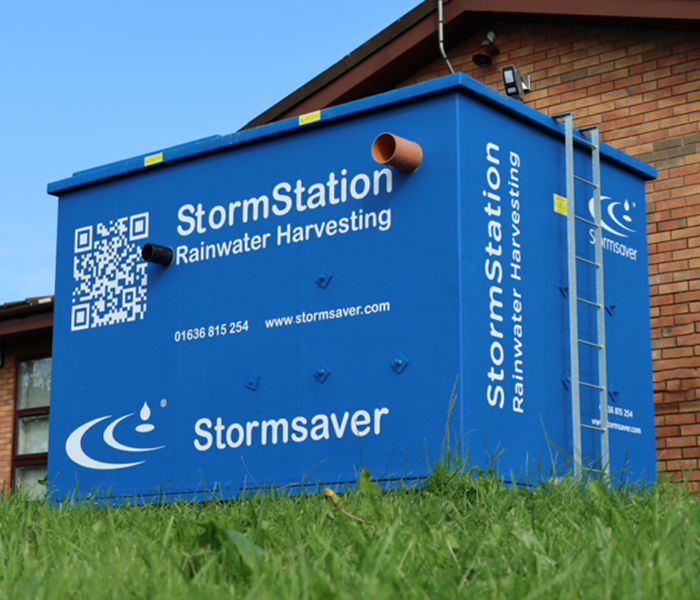
Combi (most schools, colleges and universities), non-pressurised (larger, higher-demand campuses) and StormStation for retrofit or space-constrained sites.
Design and delivery
Free site survey, sizing to BS EN 16941-1, full working drawings and units pre-assembled and tested before they leave the factory.
Added-value options
UV disinfection, automatic backwash filtration, the Monitoring Display and BMS connectivity.
Maintenance
Bi-annual servicing, tank cleaning, legionella testing and UV lamp replacement, the ongoing work that keeps a system reliable through term after term.
Compliance and funding drivers for education centres
BS EN 16941-1:2024
BREEAM Wat 01
The 2025 National Standards for SuDS
Sector-specific drivers
All Stormsaver commercial systems are designed to this standard, the UK reference for on-site non-potable water systems. Sizing runs two calculations: the roof’s realistic rainwater yield and the building’s actual non-potable demand and adopts the smaller of the two.
Most new-build and major refurbishment education projects are assessed against BREEAM and water consumption (Wat 01) is a credit category where rainwater harvesting does reliable, predictable work. Under BRE’s Wat 01 methodology, meeting up to 75% of non-potable demand with recycled or harvested water earns 5 credits, with an additional exemplary credit available at 95%. Because toilet flushing needs no behaviour change from occupants, it’s a dependable route to those credits rather than one reliant on how people use the building.
DEFRA published new National Standards for Sustainable Drainage Systems in June 2025, applying to major developments. Under the revised runoff-destination hierarchy, collecting rainwater for non-potable reuse now sits at the top. The standards remain non-statutory in England, enforced through planning conditions rather than a separate approval regime, but the direction is clear: rainwater harvesting is increasingly the expected first answer to surface water on new campus buildings, not an optional add-on.
The Department for Education’s Sustainability and Climate Change Strategy commits every education setting to nominate a sustainability lead and put a climate action plan in place, working towards a 50% reduction in public sector emissions by 2032. Universities across the UK have made their own net-zero commitments with published target dates, adding water stewardship to the list of metrics reported to students, staff and investors. For bursars and business managers, there’s a simpler driver alongside all of this: rising water and wastewater charges make a free, on-site resource increasingly hard to ignore.
BS EN 16941-1:2024
All Stormsaver commercial systems are designed to this standard, the UK reference for on-site non-potable water systems. Sizing runs two calculations: the roof’s realistic rainwater yield and the building’s actual non-potable demand and adopts the smaller of the two.
BREEAM Wat 01
Most new-build and major refurbishment education projects are assessed against BREEAM and water consumption (Wat 01) is a credit category where rainwater harvesting does reliable, predictable work. Under BRE’s Wat 01 methodology, meeting up to 75% of non-potable demand with recycled or harvested water earns 5 credits, with an additional exemplary credit available at 95%. Because toilet flushing needs no behaviour change from occupants, it’s a dependable route to those credits rather than one reliant on how people use the building.
The 2025 National Standards for SuDS
DEFRA published new National Standards for Sustainable Drainage Systems in June 2025, applying to major developments. Under the revised runoff-destination hierarchy, collecting rainwater for non-potable reuse now sits at the top. The standards remain non-statutory in England, enforced through planning conditions rather than a separate approval regime, but the direction is clear: rainwater harvesting is increasingly the expected first answer to surface water on new campus buildings, not an optional add-on.
Sector-specific drivers
The Department for Education’s Sustainability and Climate Change Strategy commits every education setting to nominate a sustainability lead and put a climate action plan in place, working towards a 50% reduction in public sector emissions by 2032. Universities across the UK have made their own net-zero commitments with published target dates, adding water stewardship to the list of metrics reported to students, staff and investors. For bursars and business managers, there’s a simpler driver alongside all of this: rising water and wastewater charges make a free, on-site resource increasingly hard to ignore.
Education Rainwater Harvesting FAQs
Do schools need a different rainwater harvesting system to other commercial buildings?
Not fundamentally different, but the redundancy needs to be higher. A Combi or non-pressurised system is standard, with mechanical ball valves on the break tank and automatic mains backup.
Combi or non-pressurised Rainwater Harvesting Systems?
It comes down to peak demand. Combi suits most schools and colleges, where demand sits at or below 620 litres an hour. Larger campuses or buildings with heavier, more concentrated toilet use are better served by a non-pressurised system.
Is rainwater harvesting safe for use in a building full of children?
Yes, when specified and installed to BS EN 16941-1. UV disinfection is standard practice on education sites, paired with third-stage automatic backwash filtration to keep it effective. The water is never mixed with the mains supply and outlets are clearly separated and labelled.
What happens if the system fails or there's a dry spell?
Automatic mains-water backup takes over without any manual intervention, so washrooms stay in service. Mechanical ball valves on the break tank also prevent a stuck-open solenoid from running mains water continuously until the next service visit.
Do we need UV disinfection?
It’s commonly specified for education sites given the number of occupants and it’s required wherever water is used in fine vapour or spray form, such as irrigation. Where UV is used, an automatic backwash filter is needed alongside it to prevent particles shielding pathogens from the UV light.
Will rainwater harvesting help with BREEAM credits?
Yes. Under Wat 01, meeting up to 75% of non-potable demand with harvested rainwater earns 5 credits, with an additional exemplary credit available at 95%. Toilet flushing is a dependable route to those credits because it needs no change in occupant behaviour.
How much maintenance does the system need?
Bi-annual servicing, tank cleaning, legionella testing and UV lamp replacement. This is what keeps the system reliable term after term and it’s worth budgeting for as part of the whole-life cost, not just the installation.