Rainwater Solutions
Rainwater Harvesting for Logistics and Distribution Centres
A distribution centre’s roof is one of the largest untapped assets on the site. It collects thousands of litres of rainwater that most schemes simply send to drain, while the building pays mains rates to flush toilets and wash its fleet, and spends again on the attenuation needed to satisfy planning.
Commercial rainwater harvesting resolves both at once: it turns that roof into a reliable non-potable water supply and helps meet your SuDS and drainage obligations in the same system. But logistics sites have their own quirks, vast roofs paired with surprisingly modest demand, heavy vehicle-washing loads, and separate warehouses or office buildings to serve. Getting the design right takes specialist knowledge.
With over 20 years designing commercial water reuse systems, Stormsaver can size, manufacture, install and maintain rainwater harvesting for distribution and logistics schemes across the UK.
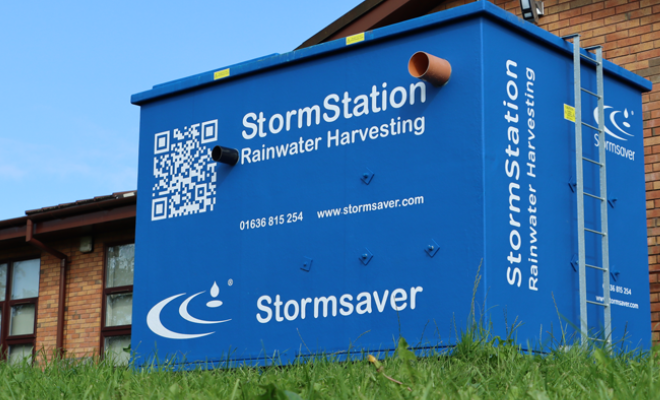
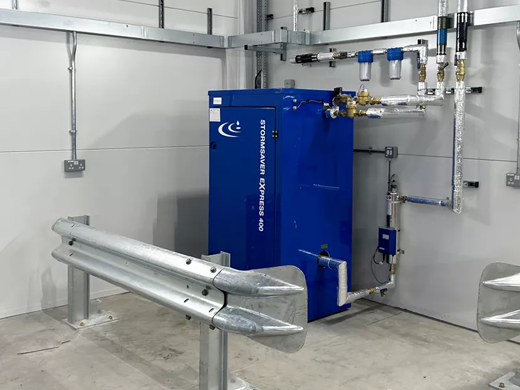
Why logistics and distribution centres are ideal candidates
Few building types suit rainwater harvesting as well as a distribution centre, for three reasons:
- A large catchment: A big impermeable roof collects a great deal of rainfall, and a well-designed system can capture up to around 80% of it.
- The right kind of demand: Toilet flushing, HGV and fleet washing, irrigation, dust suppression and process or cooling water are all non-potable uses. None needs mains-quality water, so none needs to draw on the mains.
- Steady, year-round use: These buildings run continuously, so the supply is put to work consistently rather than sitting idle.
Across more than 2,500 sites, Stormsaver typically meets up to 75% of a building’s non-potable demand with harvested rainwater. On a distribution centre, a huge roof combined with high washdown demand, that makes a material difference to the water bill.
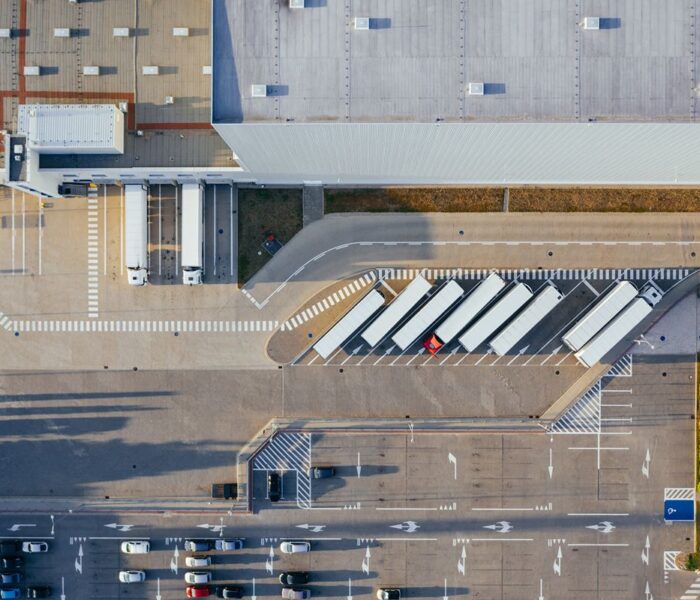
Why a huge roof usually means a smaller tank than you'd expect
It seems obvious that a massive roof needs a massive tank. In practice, the opposite is usually true: tank size is governed by demand, not roof area.
This is the logic set out in BS EN 16941-1, the standard for on-site non-potable water systems. Sizing a system runs two calculations, the rainwater the roof can realistically yield over a year, and the building’s actual non-potable demand and adopts the smaller of the two as the basis for storage.
On a logistics scheme, demand is almost always the limiting factor. A warehouse has an enormous roof but a small, sparsely distributed headcount: a few welfare cores serving a large floorplate. The roof’s annual yield can run into the millions of litres while genuine demand sits in the tens of thousands, so the demand-led figure sets the tank size. Tanks are then typically sized to hold around 18 days’ worth of demand, enough to ride out the average UK dry spell, with a climate-change allowance built into the calculation.
The result is a correctly sized rainwater harvesting tank that costs less, takes up less of your footprint, and turns its water over more often, keeping quality high. Oversizing to “match the roof” means paying for storage the building can never use.
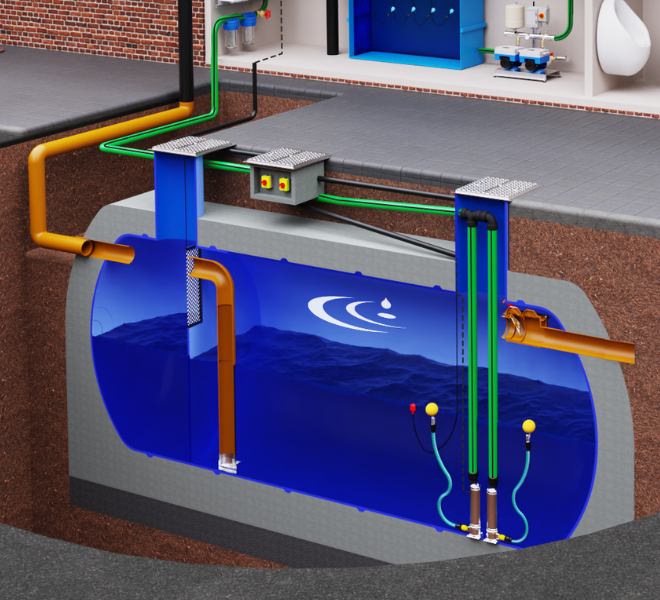
How Rainwater Harvesting Works
1. Collection
Rainwater harvesting systems collect rainwater from the roof via gutters and downpipes. The water is then directed to the pre-filtration system before entering the storage tank. Roof area and rainfall levels determine the amount of water collected.
2. Pre-filtration
Rainwater passes through a high-efficiency pre-filter that removes leaves, debris, and particles. This protects the storage tank and improves water quality.
3. Storage
Filtered rainwater is stored in a rainwater harvesting tank, which can be installed above ground or below ground. Tank size is designed based on roof area, rainfall, and building water demand.
4. Distribution
Stored rainwater is pumped to toilets, irrigation systems, and other non-potable uses via a secondary break tank. An automatic mains water backup ensures continuous supply when rainfall is low.
Vehicle and fleet washing: the demand that changes the maths
There’s one major exception to the “smaller than you’d expect” rule, and on logistics sites it’s a common one: vehicle and fleet washing.
Washing HGVs is water-hungry. A single wash cycle uses around 400 to 600 litres, far more than any other routine demand on site. A centre washing 100 HGVs a day can get through roughly 14,560 m³ a year on truck washing alone, of which around 75% can be supplied from harvested rainwater. This demand can easily exceed what a demand-led tank would hold, leaving the system to fall back on mains water for the bulk of the washdown, exactly the cost you were trying to design out.
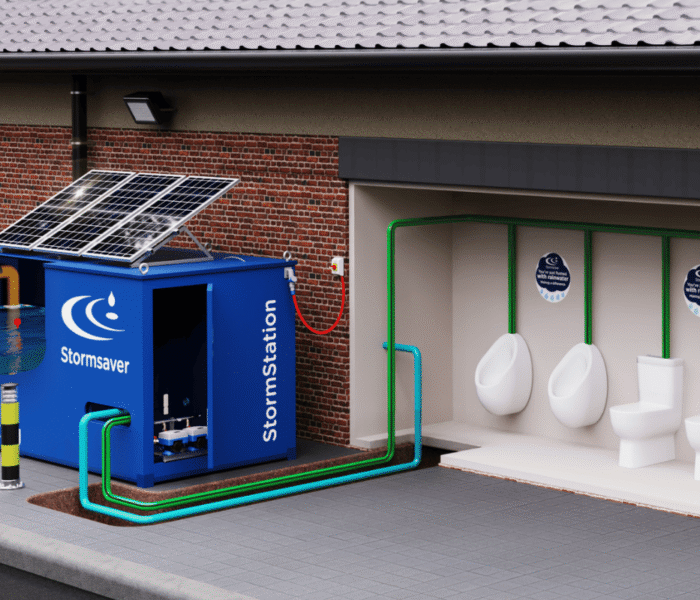
The answer is to stop treating the rainwater tank and the site’s attenuation storage as two separate things. A logistics site almost always needs stormwater attenuation for planning, so that large stored volume shouldn’t sit idle. Linking the rainwater harvesting system to the attenuation capacity through Smart SuDS makes it available to cover the majority of the vehicle-washing demand, while still guaranteeing full storm capacity whenever rain is forecast. The water you were storing for flood compliance does double duty as washdown supply.
Why Smart SuDs Works
The drainage problem with big roofs
A large impermeable roof plus extensive hardstanding produces a lot of surface water runoff, fast. To grant planning permission, LLFAs require that runoff to be attenuated, held back and released slowly so it doesn’t overwhelm the network downstream. The conventional answer is an attenuation tank that sits empty most of the year, waiting for a storm: dead capital, taking up land and doing nothing on every dry day.
How Smart SuDS works
Smart SuDS combines rainwater harvesting and attenuation in a single system. It uses Met Office forecasts, looking up to 72 hours ahead, to draw stored water down before a storm arrives, so there’s always room to catch the incoming rainfall. The control valve fails open and reverts to passive attenuation if anything goes wrong, with battery backup, BMS connectivity and automatic alerts, so 100% of the required attenuation capacity is always available, even while the storage is in active use the rest of the time.
The results are significant: runoff rates reduced by up to 95% where rainwater harvesting is combined with Smart SuDS, alongside up to 75% of non-potable demand met. For retrofit and constrained sites, StormStation Active offers a modular, plug-and-play combined attenuation and rainwater unit.
Why this suits rainwater harvesting for distribution centres
The reasoning is straightforward: these sites need large attenuation volumes anyway, and they often have a high washdown demand that can put that stored water to productive use. Pairing the two turns a required planning cost into a working asset.
One Site, Two Systems
A logistics development is rarely a single building. It’s typically a large warehouse plus an adjoining office block, and the two have very different water profiles: the warehouse serves washdown and a handful of welfare cores, while the office has a concentrated cluster of WCs serving a denser population.
Best practice is to specify two separate rainwater harvesting systems on one site, one for each building, each sized to its own demand. Each system runs in isolation, each is right-sized for its actual use, and the site gains resilience: if one needs maintenance, the other carries on regardless.
On a mixed-use warehouse development in Northampton, a leading developer came to Stormsaver with a planning requirement to reduce the scheme’s environmental impact. The solution was two separate Combi systems, each sized to its building and fed by underground tanks of 3,000 and 5,000 litres. Operating the buildings independently mattered here; the units had different tenants on completion, so a single integrated system would have tied them together awkwardly.
Compliance and credits: how rainwater harvesting de-risks your planning application
The 2025 National Standards for SuDS
BREEAM Wat 01 (Water Consumption)
LLFAs and the drainage strategy
Standards, certification and water safety
In June 2025, DEFRA published new National Standards for Sustainable Drainage Systems, applying to major developments in England, including non-residential sites of one hectare or larger, a threshold most distribution centres clear comfortably. The key change is the runoff-destination hierarchy: collecting rainwater for non-potable reuse now sits at the top priority, above infiltration, discharge to a watercourse, and discharge to a sewer. Designers must justify in writing why any higher option isn’t being used, and higher cost alone isn’t an acceptable reason to drop down it.
These standards remain non-statutory in England, enforced through planning conditions rather than a separate approval regime, but many planning authorities are already applying them. For a logistics scheme, the practical implication is that rainwater harvesting is increasingly the default first answer to surface water, not an optional extra.
Most new logistics schemes now target BREEAM Excellent or Outstanding, and water is a category where rainwater harvesting does reliable work. Harvested rainwater offsets potable demand and directly improves the building’s water-efficiency score and because toilet flushing needs no change in occupant behaviour, it’s a dependable route to those credits rather than one that relies on people acting differently. The system does need to be specified and installed to BS EN 16941, with the appropriate flow control and leak detection in place.
The LLFA will want to see how surface water follows the SuDS hierarchy, including reuse. In practice, that means storage-capacity calculations, a clear account of the system’s role in the wider drainage strategy, defined fail-safe features so full attenuation capacity is always available, and a maintenance and de-sedimentation plan. A Smart SuDS design is built to answer exactly these questions.
Every Stormsaver system is designed in full compliance with BS EN 16941-1:2024. The non-potable supply is kept entirely separate from the potable system under Part G of the Building Regulations and the Water Fittings Regulations, with mains backup via a physical air gap and all non-potable pipework and outlets clearly labelled. Certification is provided through the recognised approval bodies and the CIRIA SuDS Manual recognises rainwater harvesting as a legitimate SuDS method.
The 2025 National Standards for SuDS
In June 2025, DEFRA published new National Standards for Sustainable Drainage Systems, applying to major developments in England, including non-residential sites of one hectare or larger, a threshold most distribution centres clear comfortably. The key change is the runoff-destination hierarchy: collecting rainwater for non-potable reuse now sits at the top priority, above infiltration, discharge to a watercourse, and discharge to a sewer. Designers must justify in writing why any higher option isn’t being used, and higher cost alone isn’t an acceptable reason to drop down it.
These standards remain non-statutory in England, enforced through planning conditions rather than a separate approval regime, but many planning authorities are already applying them. For a logistics scheme, the practical implication is that rainwater harvesting is increasingly the default first answer to surface water, not an optional extra.
BREEAM Wat 01 (Water Consumption)
Most new logistics schemes now target BREEAM Excellent or Outstanding, and water is a category where rainwater harvesting does reliable work. Harvested rainwater offsets potable demand and directly improves the building’s water-efficiency score and because toilet flushing needs no change in occupant behaviour, it’s a dependable route to those credits rather than one that relies on people acting differently. The system does need to be specified and installed to BS EN 16941, with the appropriate flow control and leak detection in place.
LLFAs and the drainage strategy
The LLFA will want to see how surface water follows the SuDS hierarchy, including reuse. In practice, that means storage-capacity calculations, a clear account of the system’s role in the wider drainage strategy, defined fail-safe features so full attenuation capacity is always available, and a maintenance and de-sedimentation plan. A Smart SuDS design is built to answer exactly these questions.
Standards, certification and water safety
Every Stormsaver system is designed in full compliance with BS EN 16941-1:2024. The non-potable supply is kept entirely separate from the potable system under Part G of the Building Regulations and the Water Fittings Regulations, with mains backup via a physical air gap and all non-potable pipework and outlets clearly labelled. Certification is provided through the recognised approval bodies and the CIRIA SuDS Manual recognises rainwater harvesting as a legitimate SuDS method.
Rainwater Harvesting for Logistics and Distribution Centre FAQs
Does the tank really get smaller as the roof gets bigger?
Often, yes. Under BS EN 16941, storage is sized on demand, not roof area. A warehouse’s huge roof produces far more potential yield than its modest headcount can use, so the demand-led figure (the smaller one) sets the tank size.
Can rainwater legally be used for HGV washing?
Yes. Vehicle washing is a non-potable use, well suited to harvested rainwater. Where washing generates aerosols, UV disinfection is recommended as best practice.
Will Smart SuDS compromise my flood or attenuation compliance?
No. The system guarantees 100% of the required attenuation capacity is always available, with fail-safe controls that revert to passive attenuation if needed, exactly what LLFAs want to see.
Is rainwater harvesting now mandatory on logistics sites?
Not statutorily in England, but under the 2025 National Standards for SuDS it sits at the top of the runoff hierarchy, so on most major schemes you’d need to justify in writing why you aren’t using it. In practice it’s the expected first option.