Commercial Rainwater Harvesting
Rainwater Harvesting for the Public Sector
Public bodies are under pressure from three directions at once: legally binding net zero commitments, budgets that have to stretch further every year and a level of public scrutiny most private organisations never face. Water sits at the intersection of all three. It’s a cost that’s rising, a target that’s tracked and a resource that’s visibly wasted if it isn’t managed well.
Rainwater harvesting addresses all three at once and it does it without asking anyone to change how they use the building. Stormsaver has been designing, manufacturing and maintaining water reuse systems for the UK public estate for over 20 years, with installations across local authorities, the police service and HM Prison Service.
Find out more about our commercial rainwater harvesting solutions.
A broad opportunity, not just a defence one
Public sector and government buildings cover a wide range of building types and rainwater harvesting has a role on almost all of them:
- Local authority and civic buildings – council offices, town halls, libraries, depots and leisure centres.
- The blue light estate – police and fire stations.
- Justice – courts and the custodial estate.
- NHS and healthcare – hospitals, clinics and health centres.
- Central government – departmental offices and government hubs.
- Armed forces and defence – a distinct sub-segment covered in detail below.
What these buildings share is what makes rainwater harvesting work: a substantial roof catchment, high non-potable demand from toilet flushing, irrigation or washdown and a binding sustainability duty that has to be reported against.
Public sector compliance
Greening Government Commitments (GGCs)
NHS net zero
MOD and defence
BREEAM Wat 01 and the SuDS hierarchy
The GGCs set binding, cross-government targets for water, carbon, waste and nature recovery across the central government estate, reported quarterly by every department. The 2021-2025 framework required departments to reduce water consumption by at least 8% from a 2017-18 baseline; several departments went well beyond it. Defra, for example, reported a 20% reduction against that 8% target. The 2025-2030 framework carries the ambition forward, with departments such as DWP committing to reduce potable water consumption by at least 3% from 2025-26 levels as part of their published water management plans. Rainwater harvesting reduces exactly the metric these commitments measure: potable, mains-supplied water.
The NHS became the first health system in the world to put net zero into legislation, under the Health and Care Act 2022. The target is net zero by 2040 for the emissions the NHS controls directly, which includes water, with an 80% reduction required by 2028-2032 and net zero by 2045 for the wider emissions it can influence. Every trust and integrated care board now needs a board-approved Green Plan and water consumption sits within its scope.
Defence accounts for around half of UK central government’s emissions and the Ministry of Defence has its own net zero commitments across the estate. More specifically for specifiers: the MOD’s environmental assessment methodology for defence projects, DREAM, mandates the use of rainwater harvesting on new schemes unless there’s a strong justification not to use it, which makes rainwater harvesting the default expectation, not an optional extra, on MOD projects.
Most new-build and major refurbishment public buildings are assessed against BREEAM, where Wat 01 rewards reduced potable water demand; up to 5 credits are available and achieving at least 1 credit is the minimum standard required for a “Very Good” rating or above. Rainwater systems need to be specified to BS EN 16941-1 to count toward the calculation. Separately, DEFRA’s National Standards for SuDS, published in June 2025, now place rainwater reuse at the top of the runoff-destination hierarchy reframing surface water on public sites as a resource to capture first, not a problem to drain away.
Greening Government Commitments (GGCs)
The GGCs set binding, cross-government targets for water, carbon, waste and nature recovery across the central government estate, reported quarterly by every department. The 2021-2025 framework required departments to reduce water consumption by at least 8% from a 2017-18 baseline; several departments went well beyond it. Defra, for example, reported a 20% reduction against that 8% target. The 2025-2030 framework carries the ambition forward, with departments such as DWP committing to reduce potable water consumption by at least 3% from 2025-26 levels as part of their published water management plans. Rainwater harvesting reduces exactly the metric these commitments measure: potable, mains-supplied water.
NHS net zero
The NHS became the first health system in the world to put net zero into legislation, under the Health and Care Act 2022. The target is net zero by 2040 for the emissions the NHS controls directly, which includes water, with an 80% reduction required by 2028-2032 and net zero by 2045 for the wider emissions it can influence. Every trust and integrated care board now needs a board-approved Green Plan and water consumption sits within its scope.
MOD and defence
Defence accounts for around half of UK central government’s emissions and the Ministry of Defence has its own net zero commitments across the estate. More specifically for specifiers: the MOD’s environmental assessment methodology for defence projects, DREAM, mandates the use of rainwater harvesting on new schemes unless there’s a strong justification not to use it, which makes rainwater harvesting the default expectation, not an optional extra, on MOD projects.
BREEAM Wat 01 and the SuDS hierarchy
Most new-build and major refurbishment public buildings are assessed against BREEAM, where Wat 01 rewards reduced potable water demand; up to 5 credits are available and achieving at least 1 credit is the minimum standard required for a “Very Good” rating or above. Rainwater systems need to be specified to BS EN 16941-1 to count toward the calculation. Separately, DEFRA’s National Standards for SuDS, published in June 2025, now place rainwater reuse at the top of the runoff-destination hierarchy reframing surface water on public sites as a resource to capture first, not a problem to drain away.
How rainwater harvesting works
1. Collection
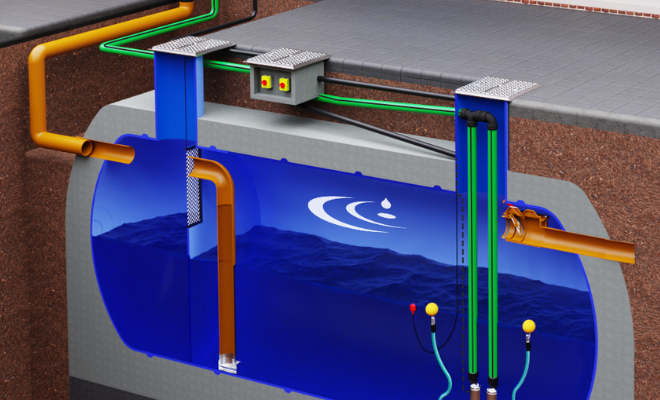
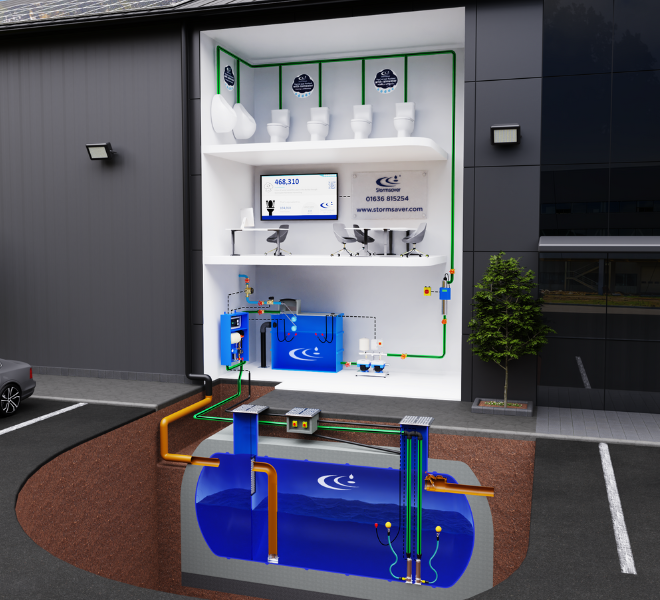
Rainwater harvesting systems collect rainwater from the roof via gutters and downpipes. The water is then directed to the pre-filtration system before entering the storage tank. Roof area and rainfall levels determine the amount of water collected.
2. Pre-filtration
Rainwater passes through a high-efficiency pre-filter that removes leaves, debris, and particles. This protects the storage tank and improves water quality.
3. Storage
Filtered rainwater is stored in a rainwater harvesting tank, which can be installed above ground or below ground. Tank size is designed based on roof area, rainfall, and building water demand.
4. Distribution
Stored rainwater is pumped to toilets, irrigation systems, and other non-potable uses via a secondary break tank. An automatic mains water backup ensures continuous supply when rainfall is low.
Armed forces and defence facilities
Defence sites have a demand profile that makes them among the strongest rainwater harvesting cases anywhere in the public estate. Two things drive it: a large, continuous requirement for vehicle washdown across a military fleet and very high toilet-flushing demand from the number of personnel on base. Both map directly onto what harvested rainwater is suited to supply.
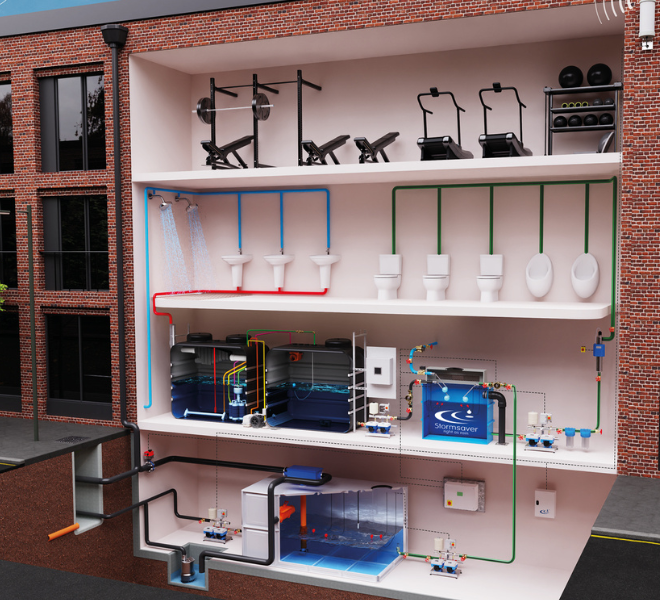
Where a site also has residential accommodation (barracks or single living quarters) there’s a second opportunity that non-residential public buildings simply don’t have: greywater recycling. Showers and hand basins in accommodation blocks generate a steady, weather-independent supply of greywater that Stormsaver’s Aqualoop system collects, ultra-filters and returns for non-potable reuse. Because it doesn’t depend on rainfall, greywater pairs naturally with rainwater harvesting on sites where the two demands (vehicle washdown and toilet flushing) are both high: rainwater covers what the roof can yield and greywater from the accommodation blocks fills the gap.
Combined with the DREAM mandate, this makes defence sites with residential accommodation some of the most compelling rainwater and greywater business cases in the public sector.
How to specify the Stormsaver system
Matching the system to the building
Getting the sizing right
Monitoring and demonstrating outcomes
- Non-pressurised systems – the standard choice for buildings with large-scale demand and many toilets. A main tank feeds a header tank via booster pumps, with automatic mains switchover keeping the supply uninterrupted through maintenance or a component fault. Well suited to hospitals, large civic buildings and bigger barracks blocks.
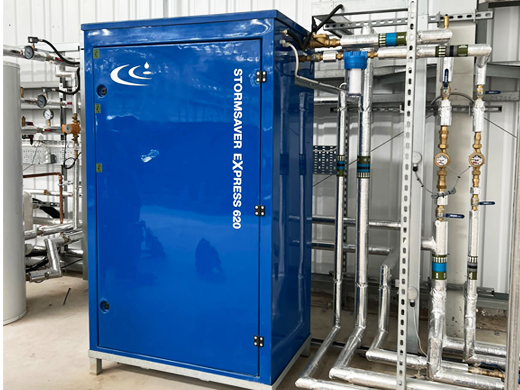
- Combi systems – a compact, pre-wired unit combining a header tank, booster set and controls in one housing, available in 225, 400 and 620 litre capacities. A strong fit for offices, leisure centres and other buildings with high but not extreme demand.
- Pressurised systems – compact and suited to smaller buildings, such as satellite stations with fewer than around 10 toilets.
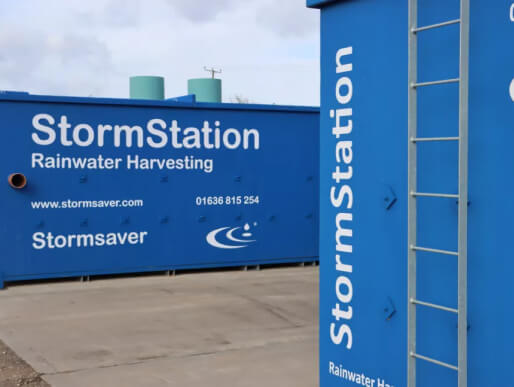
- StormStation – a plug-and-play, fully self-contained unit for retrofit, space-constrained or limited-excavation sites, available from 3,000 to 20,000 litres, with an optional photovoltaic supply for a carbon-neutral installation.
Systems are sized to BS EN 16941-1: the smaller of the roof’s realistic rainwater yield and the building’s actual non-potable demand sets the storage volume. The British Standard doesn’t cover internal storage sizing and getting that wrong, undersizing the break tank, is the single biggest reason UK systems underperform, so it’s worth specifying with someone who sizes it specifically. Filtration is built in as standard (a 1,000-micron pre-tank filter and floating suction filter), with automatic backwash filtration and UV disinfection available as a third stage where higher water quality is needed.
Every system includes rainwater and mains meters as standard, alongside PLC controls with BMS connectivity for storage levels, consumption and faults. A visible monitoring display is also available, useful on civic, health and education sites where demonstrating environmental performance to the public has real value.
Matching the system to the building
- Non-pressurised systems – the standard choice for buildings with large-scale demand and many toilets. A main tank feeds a header tank via booster pumps, with automatic mains switchover keeping the supply uninterrupted through maintenance or a component fault. Well suited to hospitals, large civic buildings and bigger barracks blocks.
- Combi systems – a compact, pre-wired unit combining a header tank, booster set and controls in one housing, available in 225, 400 and 620 litre capacities. A strong fit for offices, leisure centres and other buildings with high but not extreme demand.
- Pressurised systems – compact and suited to smaller buildings, such as satellite stations with fewer than around 10 toilets.
- StormStation – a plug-and-play, fully self-contained unit for retrofit, space-constrained or limited-excavation sites, available from 3,000 to 20,000 litres, with an optional photovoltaic supply for a carbon-neutral installation.
Getting the sizing right
Systems are sized to BS EN 16941-1: the smaller of the roof’s realistic rainwater yield and the building’s actual non-potable demand sets the storage volume. The British Standard doesn’t cover internal storage sizing and getting that wrong, undersizing the break tank, is the single biggest reason UK systems underperform, so it’s worth specifying with someone who sizes it specifically. Filtration is built in as standard (a 1,000-micron pre-tank filter and floating suction filter), with automatic backwash filtration and UV disinfection available as a third stage where higher water quality is needed.
Monitoring and demonstrating outcomes
Every system includes rainwater and mains meters as standard, alongside PLC controls with BMS connectivity for storage levels, consumption and faults. A visible monitoring display is also available, useful on civic, health and education sites where demonstrating environmental performance to the public has real value.
What makes Stormsaver the right choice?
Across roughly 2,000 monitored Stormsaver installations, the average water saving is 75% and on some public sector sites it runs higher still. At Avon and Somerset Police centres, harvested rainwater consistently supplies around two-thirds of total water usage. These savings are achieved without any change in how staff or visitors use the building, which matters for services that run continuously and can’t ask occupants to alter their behaviour.
Beyond the mains, rainwater has a lower carbon footprint than treated mains water, supporting the emissions side of net zero commitments as well as the water side. And with UK public sector water spend running into the hundreds of millions of pounds a year, even modest percentage reductions translate into budget that can be redirected to frontline services rather than utility bills.

Working with Stormsaver
Stormsaver is a UK manufacturer based in Nottinghamshire, with over 20 years’ experience and more than 2,500 water reuse installations completed. We are the UK’s largest provider of rainwater harvesting maintenance, supporting over 1,500 customers and hold Constructionline Gold, CHAS and Safecontractor accreditations relevant to public sector procurement. For specifiers, we can provide BIM content, a specification tool, CPD sessions and a technical team on hand throughout design, manufacture, installation, commissioning and ongoing maintenance.
Public Sector Rainwater Harvesting FAQs
Do all public sector buildings qualify for rainwater harvesting or just large sites like barracks?
Any building with a reasonable roof area and steady non-potable demand is a candidate. Council offices, police stations, courts and health centres all qualify, not just large defence or industrial-scale sites. The business case depends on that combination of roof and demand, not on the building type.
Does rainwater harvesting count towards our net zero or GGC targets?
Yes. It reduces potable water consumption, which is the specific metric tracked under the Greening Government Commitments and reported by NHS trusts under their Green Plans. It also lowers embodied carbon compared with treated mains water, supporting the emissions side of net zero reporting as well.
Is greywater recycling only relevant to defence sites with barracks?
Largely, yes, within this vertical, it depends on having residential accommodation with showers and hand basins on site, which is common on defence bases but rare in council offices, courts or police stations. Where that accommodation exists, greywater pairs well with rainwater harvesting because it doesn’t depend on rainfall.
Will specifying rainwater harvesting slow down a public sector procurement process?
No. Stormsaver holds Constructionline Gold, CHAS and Safecontractor accreditations relevant to public sector procurement and provides BIM content and a specification tool to support standard tendering routes rather than requiring a bespoke process.
How much of our water use can rainwater harvesting realistically replace?
Across Stormsaver’s monitored installations, the average saving is 75% of non-potable demand and some public sector sites run higher; Avon and Somerset Police centres currently source around two-thirds of total water usage from harvested rainwater. The exact figure depends on roof area and demand, which is why sizing is done per site.