There are currently lots of debates following the consultation on Part G of the Building Regulations over whether rainwater harvesting and greywater recycling should be made mandatory in new commercial and domestic developments in the UK.
The recent consultation asked the key question: should rainwater harvesting and greywater technologies be a part of the Building Regulations?
This expert article will provide an impact analysis to show the water-saving potential, as well as list the wider benefits.
This article is designed for policy makers, water companies, building design engineers, and anyone who has a part to play in the wider discussion on water reuse.
With 60% of the 5 billion daily water deficit forecast by 2055 being solved through greater water efficiency, water reuse technologies will play a key role.
What we will cover…
- Brief overview of rainwater harvesting, greywater recycling and water reuse
- Brief situation analysis
- The impact on water supplies
- What action is needed

About water reuse technologies in the UK
More recently, the term water reuse has been used to define reclaimed water for non-potable use on a building scale.
This is different from water recycling as a term, which is much more associated with large-scale effluent reuse on a regional basis.
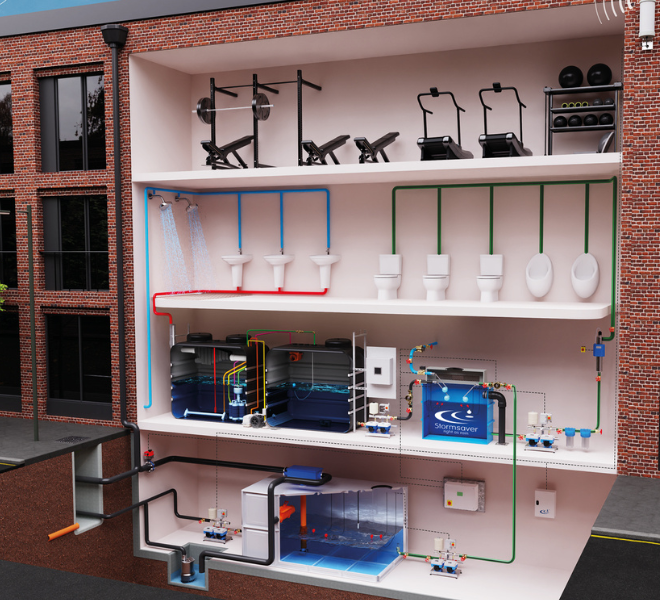
Within water reuse is the term rainwater harvesting, which covers the collection of rainfall from the roof area of a building. This rainfall is collected, safely treated, and pumped back into the building as a non-potable (non-drinking) supply.
Rainwater harvesting technologies became more popular in the UK around the turn of the century in the 2000s, but the market is still relatively constrained by legislation and the ability for developers to value engineer the technology out of the building design.
Around the 2010s, greywater recycling technologies started to be implemented following their success in Europe.
Greywater recycling is the collection of lightly used wastewater from showers, handwash basins, and bathtubs. The greywater is collected, extensively treated, and redistributed as a non-potable supply.
Globally, water reuse technologies have been more embraced by policymakers compared to here in the UK, with Belgium, Australia, France, and areas of Germany having a better legislative environment compared to the UK.
UK-specific water reuse situation analysis
Commercial systems have relatively few legislative barriers to contend with. These systems have been popular with commercial developers who are looking to achieve higher BREEAM ratings on their buildings.
However, there is currently no obligation under the water efficiency requirements of the Building Regulations for a developer to include water reuse. As a result, this leads to systems being removed from the specification due to value engineering.
Domestically, water reuse can be achieved on an optional basis via individual plot systems. However, for safety, public health, and ease of maintenance, it is recommended that medium and large developments use a communal approach to water reuse.
Ideally, these communal systems would be owned, adopted, and maintained by water companies; however, the Water Industry Act 1991 currently prevents them from doing so.
Overall, a single, unified piece of legislation is needed for both commercial and domestic settings to increase uptake of these vital systems here in the UK.
The impact on water supplies
There is potential for water reuse to dramatically reduce the 2055 national water deficit, but only if it is mandated as part of the Building Regulations in all new commercial and residential developments.
If this were to be mandated from 2030, by 2055, we could reduce the deficit by 21%.
However, the later we implement water reuse as part of the Building Regulations, the less we can save.
For example, if we wait to mandate water reuse until 2035, by 2055, we would only reduce the national deficit by 17%.
If we mandate from 2040, this drops further to just a 13% saving against the deficit.
This impact figure has been calculated using the following approach…
- Residential savings – this is based on a 25-litre per person, per day saving (Future Homes Hub Water Ready Report, 2023), an average occupancy of 2.4 per home, and an average construction rate of 250,000 new homes per year.
- Commercial savings – this is based on an average construction rate of 2,600 new commercial properties per year, all saving 10m3 per day through rainwater harvesting (Ricardo, 2017).
What action is required to increase uptake
Changes to Part G of the Building Regulations 2010
This should be amended to mandate reuse in new commercial developments over 500m2 and residential developments with 100 homes or more.
Introduce a single, readily accessible standard for water reuse
Currently, technical standards for water reuse are provided via a document locked behind a paywall on the British Standards Institution website. For simplicity, clarity, and safety, this should be a readily available document on the GOV.UK website.
Increase financial incentives for water reuse
Currently, new connections incorporating water reuse can claim an environmental discount. However, these differ in value depending on the water supplier and are not universal to commercial properties. An improved, unified approach should be implemented for simplicity.
Changes to the Water Industry Act 1991
Sections 218 and 68 should be amended to allow water companies to own and adopt communal rainwater harvesting schemes.