Drought declared across half of England. The answer isn’t just new big infrastructure – it’s local water reuse
The Environment Agency has declared that half of England is now officially in drought, highlighting the growing pressure on the UK’s water resources.
With three droughts in the past five years and 10 of the hottest summers on record occurring since 2002, water resilience can no longer be treated as a long-term challenge.
The government’s drought announcement highlighted plans to build nine new reservoirs between 2033 and 2040. These projects are an important part of securing future water supplies, but they are long-term solutions that will take years to deliver.
At the same time, the government has committed through the Clean Water Bill to remove barriers to water reuse, including rainwater harvesting and greywater recycling.
Yet these proven, practical solutions were absent from the drought announcement, despite their potential to reduce demand on drinking water supplies.
The reality is that England cannot solely rely on large new reservoirs to fill the supply and demand gap.
In this article, we’ll explore:
- Regions which are in drought
- Why major infrastructure is essential – but only part of the solution.
- How rainwater harvesting and greywater recycling can reduce pressure on public water supplies and provide a quick win for government.
- Why water reuse systems make an impact even during prolonged dry periods.

Areas which are now in drought
- East Anglia
- Hertfordshire and London
- Thames Valley
- Hampshire
- Isle of White
- Devon and Cornwall
- West Midlands
- Wessex
Areas which are now in prolonged dry weather
- Kent & East Sussex
- Cumbria & Lancashire
- Greater Manchester, Merseyside & Chesire
- East Midlands
- Lincolnshire & Northampton
- The rest of Solent & the South Downs
The constraints of major infrastructure
Major new water supply schemes are essential if the UK is to meet future demand. Under the National Water Resources Framework, 40% of the forecast 5 billion litre daily water deficit by 2055 is expected to be addressed through new supply options.
The government’s commitment to nine new reservoirs is therefore welcome. England has not built a new reservoir since 1992, despite the population growing by more than 20% over the same period.
However, major infrastructure projects are complex, expensive and slow to deliver. From planning and environmental assessments to public consultation and construction, large schemes can take decades.
The proposed Lower Thames Crossing, a comparable large infrastructure project, illustrates this challenge. Its Development Consent Order exceeds 63,000 pages, the planning process took almost 16 years, and the planning phase alone cost £1.2 billion.
Water resources are a much more immediate challenge. Communities need reliable water supplies now to support new homes, businesses and essential services.
The quick win: water reuse
While new water supplies are essential, they will only address some of the deficit. The remaining 60% must come from reducing demand through greater water efficiency.
The most effective way to achieve lasting water savings is by installing systems that are built into homes and buildings from the outset. Unlike easily removable fixtures, water reuse is built into the fabric of a property and therefore difficult to remove.
This is where rainwater harvesting and greywater recycling offer a major opportunity.
The greatest opportunity lies in new developments. Because water reuse systems require dual pipework, they are far more cost-effective to install during construction than as a retrofit.
If rainwater harvesting or greywater recycling became standard in all new homes and non-household buildings from 2030, the projected 2055 water deficit could be reduced by around 21%.
Compared with costly reservoirs and water transfer schemes, water reuse is also highly affordable. A commercial rainwater harvesting system typically costs between £16,000 and £40,000 to install, delivering immediate reductions in mains water demand.
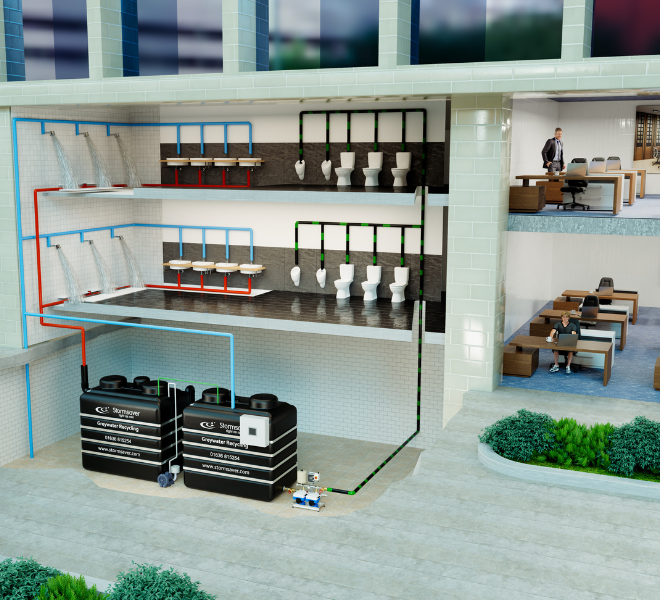
What needs to happen to accelerate water reuse in the UK?
The UK does not need to wait until late 2040 for new reservoirs to begin improving water efficiency. With the right policy, regulation and incentives, water savings from water reuse could start being delivered from 2030.
The government has already recognised the potential of water reuse through its commitment to remove barriers to these technologies. The next step is to create the regulatory and commercial environment needed to drive mainstreaming.
Our recommendations are clear:
- Make water reuse standard in new developments by requiring rainwater harvesting or greywater recycling in all new non-household buildings over 500m² and residential developments of more than 100 homes.
- Introduce clear national standards for non-potable water quality through amendments to the Water Supply (Water Quality) Regulations 2016, providing confidence and consistency for developers, water companies and regulators.
- Update the Water Industry Act 1991 by amending Sections 67, 68 and 218 to enable water companies to adopt and operate communal rainwater harvesting systems for non-potable water supplies.
- Implement the Drinking Water Inspectorate’s Water Reuse Governance Framework, including all 10 recommendations, to establish a clear governance framework for water reuse across England and Wales.
- Strengthen financial incentives for housing developers and commercial property owners to invest in rainwater harvesting and greywater recycling systems.