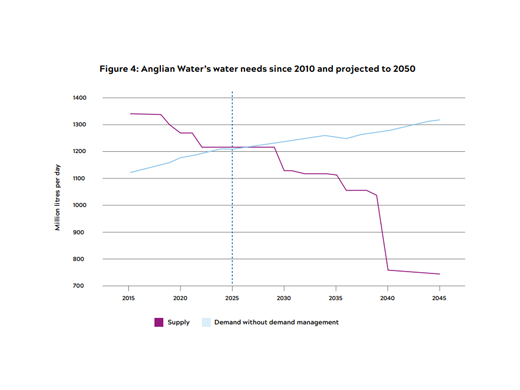
The spotlight is firmly on the water reuse industry as the UK Government looks for sustainable ways to manage demand and address the projected 5 billion litre daily water deficit by 2055.
In April 2025, Anglian Water, working in collaboration with the Environment Agency, released a landmark report that sets out a standardised hierarchy for non-potable water reuse. The guidance links potential collection sources with their most suitable applications, providing much-needed clarity for design engineers, developers, and water companies.
If you regularly specify rainwater harvesting systems, greywater recycling, or other forms of water reuse, this report offers valuable insights into which sources should be prioritised. In this blog, we’ll summarise the hierarchy and share our recommendations to help you achieve the best long-term outcomes.
Why Water Reuse Matters
The case for widespread adoption of localised water reuse systems in all new buildings is clear. The UK faces a 5 billion litre daily shortfall by 2055, and while many assume new reservoirs will close the gap, research shows that 60% of the solution must come from better demand management.
Even if every property built between 2026 and 2050 included a water reuse system, this would only reduce the national deficit by 20.5%. Retrofitting is also less effective with research by Ricardo revealing that retrofitting costs around 50% more and delivers fewer savings.
That’s why Anglian Water’s new reuse hierarchy is a critical step forward.
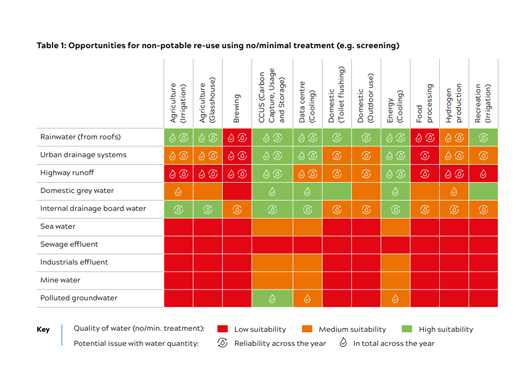
Priority 1: Rainwater Harvesting Systems
Rainwater harvesting is at the top of the hierarchy due to its ease of collection, widespread availability, and relatively simple filtration requirements.
- Best source: Roof rainwater – easiest and most cost-effective.
- Next best: Hard-standing areas – requires additional filtration such as oil separators.
- Last resort: Highways and roads – water quality issues make treatment more complex and expensive.
Our 20+ years of experience confirms that roof-based rainwater harvesting systems remain the most reliable and efficient method of delivering non-potable water reuse. Additional filtration is an absolute non-negotiable for collecting from hard standing and highways.
Priority 2: Greywater Recycling Systems
The second priority is building-scale reuse, focusing on greywater recycling from showers, handwash basins, and bathtubs. Although slightly more complex than rainwater harvesting, it is still highly achievable for new developments.
Greywater recycling is particularly powerful when combined with rainwater harvesting. This dual strategy is often implemented in high-density buildings (like apartment blocks) and facilities with high water demand (like leisure centres), significantly reducing mains water consumption.
Priority 3: Location-Specific Sources
The final level of the hierarchy includes sources such as:
- Mine water recycling
- Desalination of seawater
- Sewage effluent reuse
These options are lower priority due to complex treatment processes, high energy use, and public acceptance challenges. For example, the “yuck factor” with blackwater recycling.
While viable in specific locations, they are less sustainable compared to rainwater harvesting and greywater reuse.
Key Takeaways for Designers and Developers
If you’re a design engineer, housing developer, or water company, here’s how to apply the Anglian Water reuse hierarchy to your projects:
- Follow the hierarchy when planning non-potable water strategies.
- Plan filtration carefully, especially for hard-standing and road runoff.
- Think long term – ensure systems are easy to maintain and cost-effective over decades.
- Combine rainwater harvesting with greywater recycling wherever possible to maximise water savings.
Our experts can help you design and implement efficient water reuse systems that align with the new hierarchy. Contact us today to discuss your project.