About this guide
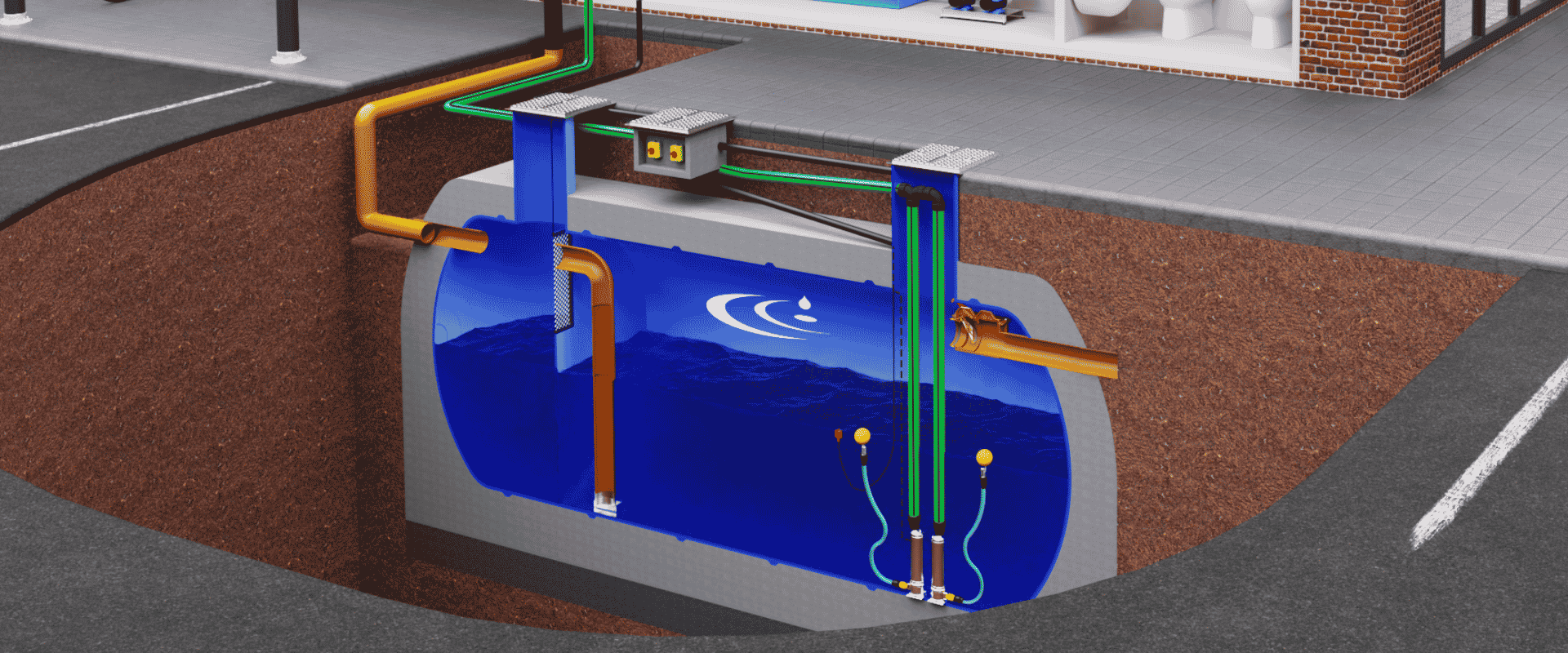
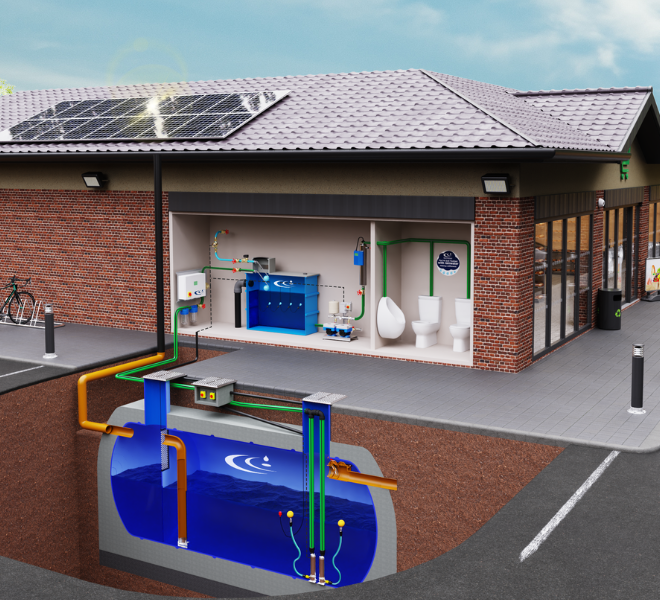
Rainwater harvesting systems are formed of storage tanks which hold the collected rainwater until it is required within the building.
Because each property has unique demand and collection characteristics, each storage tank should be sized bespoke to the building they will be located within.
In the UK, the British Standard (BS 16941-1:2024) for rainwater harvesting states that the storage tank must hold 18 days’ worth of rainwater to meet the non-potable demand.
The most resilient systems will be formed of a main storage tank and a break tank, which is located within the building. Systems without break tanks can be exposed to a higher risk of a water supply failure should a component failure occur.
This guide to rainwater harvesting tank sizing will cover…
- The purpose of the main storage tank
- The purpose of a break tank
- Basic characteristics
- How to size a main storage tank
- How to size a break tank
- The basic sizing approach according to BS 16941-1:2024
- The detailed sizing approach according to BS 16941-1:2024
- How our experts can support with sizing requirements
This guide applies to both commercial and residential rainwater harvesting systems.
The purpose of the main storage tank
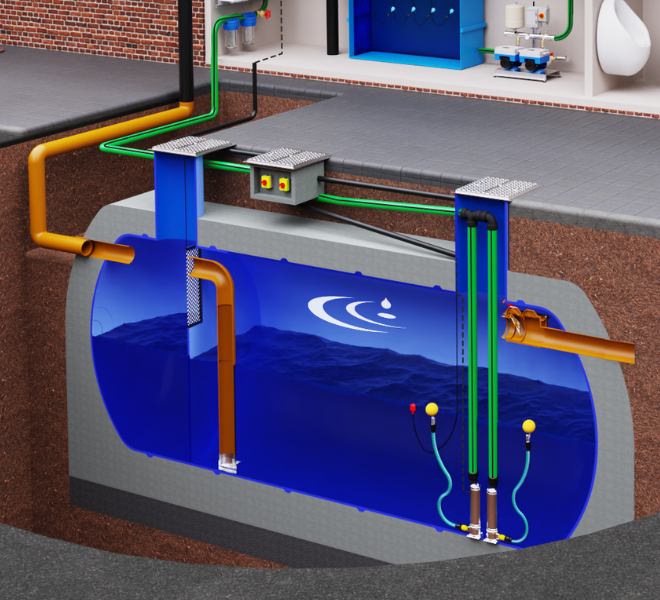
On a rainwater harvesting system, the main storage tank is the central vessel that holds rainwater until it is required within the building for a non-potable water supply.
The main storage tank is also home to some crucial components that support the system in functioning and successfully treating rainwater. These include…
- Inlet calmer – this is located on the inlet of the tank and allows fine sediment to settle on the base of the tank. This component also helps to support oxygenation of rainwater within the tank to prevent stagnation.
- Floating suction filter – this allows rainwater to be collected from the cleanest part of the main storage tank and prevents pump damage from fine debris.
- Submersible pumps – this transports rainwater into the building when a demand is detected.
The purpose of the break tank
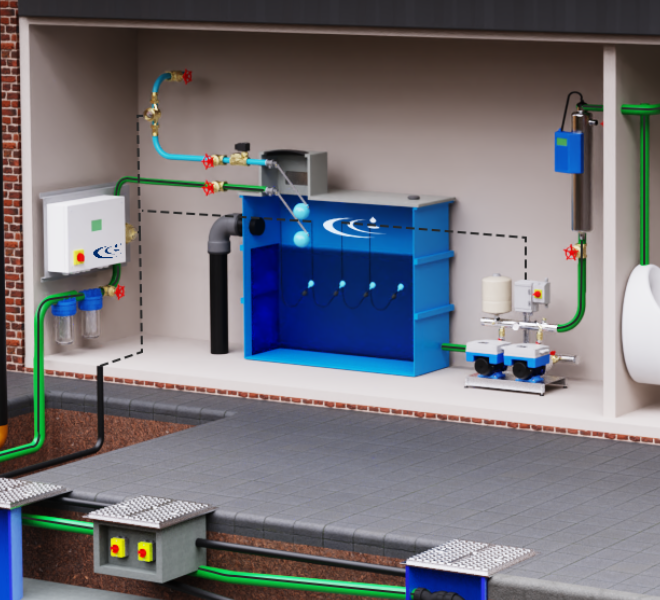
The break tank (also known as a day tank or header tank) provides a safe and compliant method of introducing mains water into a rainwater harvesting system when additional water is required.
Water regulations prohibit rainwater and mains water from coming into direct contact, as this could create a risk of contaminating the public drinking water supply. To prevent this, the break tank incorporates a compliant air gap, creating a physical separation between the two water sources.
In addition to ensuring regulatory compliance, the break tank provides two key benefits:
The two additional benefits of including a break tank are…
Efficiency
Using a break tank reduces the volume of mains water required during an automatic top-up event. Without a break tank, mains water would need to be introduced directly into the main storage tank, requiring a much larger volume of water to be added before normal operation could resume.
Reliability
The break tank helps maintain water supply continuity in the event of a rainwater harvesting system fault. Because mains water can be supplied through the break tank independently of the main rainwater equipment, water can continue to reach points of use.
How to Size the Main Rainwater Harvesting Storage Tank
BS 16941-1:2024 provides two methodologies for sizing a rainwater harvesting storage tank: the basic approach and the detailed approach. The detailed approach is recommended for commercial systems and for residential systems serving multiple properties. The basic approach provides a simplified method for determining an initial tank size.
Basic Approach
The basic approach considers both the rainwater collection potential (yield) and the non-potable water demand. The final tank size is determined by taking the lower of these two values.
1. Calculate the Collection Potential (Yield)
The yield calculation is based on:
- Roof catchment area (m²)
- Local annual rainfall (mm/year)
- Filter coefficient reductions
- Runoff coefficient for the roof type (for example, 80% runoff from a typical commercial roof)
- A storage period factor of 18 days
2. Calculate Water Demand
The demand calculation is based on:
- Building occupancy
- Number of operational days
- Daily non-potable water demand (litres/day)
- Multiplication by a storage factor of 0.05
3. Determine the Tank Size
Under the basic approach, the recommended storage volume is the smaller of the values obtained from the yield and demand calculations.
The Detailed Approach
The detailed approach to sizing a rainwater harvesting tank is the preferred method for optimising system design. It uses a more comprehensive calculation method that considers a wider range of system parameters to determine the required storage volume.
In addition to calculating the optimal tank size, the detailed approach can also be used to estimate system efficiency.
Due to the complexity of the calculation, this approach is typically undertaken by specialists such as Stormsaver.
This methodology is particularly useful for projects targeting specific levels of non-potable water substitution for sustainability certification purposes, including BREEAM. For example, where a project is targeting credits associated with higher water efficiency performance, the system can be designed to achieve a defined percentage reduction in mains water use. The tank size can then be adjusted accordingly to meet the required performance threshold.
How to Size a Rainwater Harvesting Break Tank
The sizing of the break tank is not explicitly covered within BS 16941-1:2024 for rainwater harvesting systems. However, it is a critical component of system design, and incorrect sizing can lead to operational issues.
If the break tank is undersized, incoming rainwater or mains top-up water may not replenish the system quickly enough to meet peak demand. This can result in the booster set drawing in air, which may cause cavitation, loss of prime, and potential damage to the pumping system.
The required break tank volume (in litres) is typically derived from the following key factors:
- Number of outlets served by the rainwater harvesting system
- Number of uses per outlet within a peak demand period (typically 1 hour)
- Volume of water used per outlet per use (litres)
These parameters are used to determine peak demand, which in turn informs the minimum required break tank capacity to ensure stable operations under maximum use conditions.