Communal Greywater Recycling
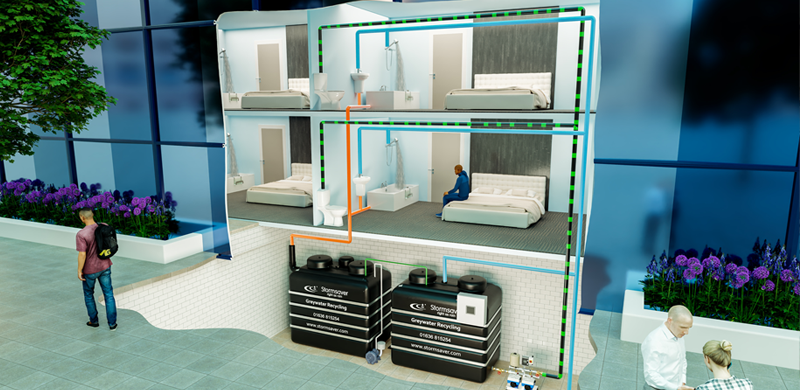
Communal greywater recycling is a centralised system that collects water from showers, hand wash basins and baths for non-potable reuse in multi-residential buildings such as student accommodation, hotels and care homes. Our systems deliver reliable long-term water savings, ensuring performance well beyond installation. Learn more below.
Strengthen Planning Applications
Who are our Communal Greywater Systems Design for?

Student Accommodation Developers
Lower operational costs in all-inclusive rent by reducing mains water demand.

Housing Associations
Enable development in water-stressed areas while supporting long-term sustainability targets.

Build-to-Rent Developers
Strengthen planning applications with water-saving measures that align with local authority priorities.
Build Sustainable Communities
Our Solutions
Our greywater solutions are designed with safety, reliability and sustainability in mind. We can support your Design Engineers with full performance specifications for your project. Learn more below.
Engineered to Save Water
Communal greywater recycling system
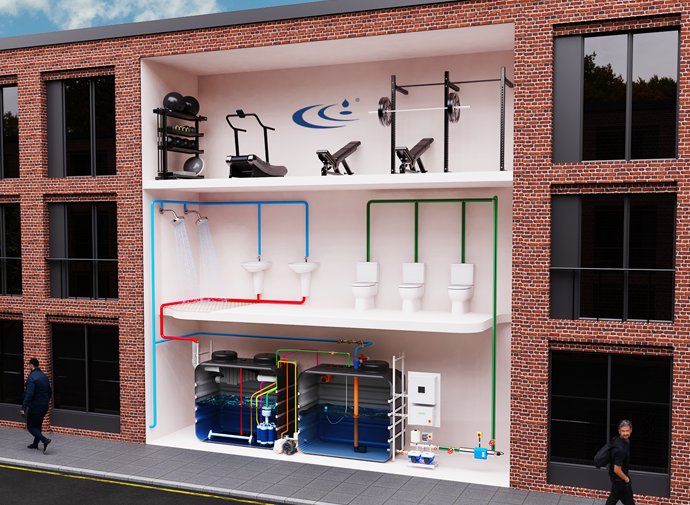
Our communal greywater systems bring the same high-performance treatment technologies used in commercial settings to multi-residential buildings. The centralised approach speeds up installation and reduces costs when compared to per-dwelling equivalents.
Designed to deliver safe, non-potable water, our systems filter greywater down to 0.02 microns – that is 3,500 times smaller than a human hair and can save up to 30 litres of mains water per person per day, supporting compliance with Part G of the Building Regulations.
- Self-cleaning pre-filter removes hair, fibres, and soaps
- Biological treatment tank promotes aerobic bacteria to break down organic matter
- Ultrafiltration membrane physically removes bacteria and viruses
- Automated chemical dosing keeps the system clean without manual intervention


Boost Water Availability
Combined Rainwater and Greywater Recycling
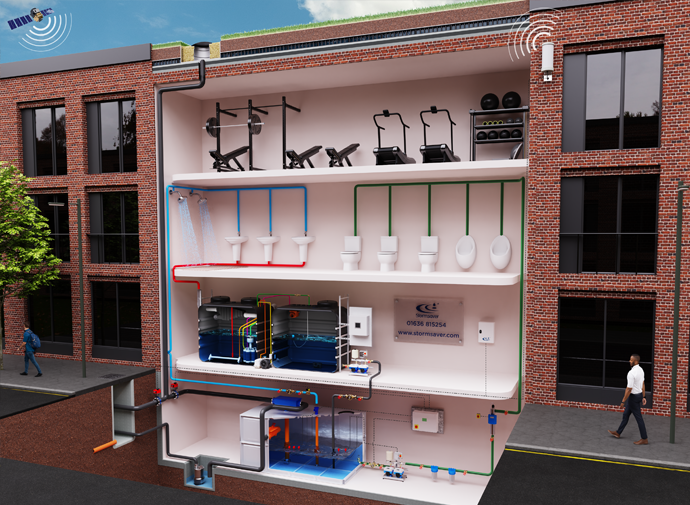
Our combined greywater and rainwater reuse systems are designed to maximise non-potable water availability. Combined systems are commonly used in large, mixed-use developments where a single collection source will not provide enough supply alone.
Our solutions treat greywater and rainwater in separate, purpose-designed filtration streams, ensuring each water type is processed using the most suited methods. Both water types then supply a shared break tank to provide a single non-potable supply.
Maintaining distinct treatment paths reduces operational strain on components, simplifies maintenance routines, and improves overall system lifespan.
With over two decades of industry, Stormsaver is a recognised leader in rainwater and greywater reuse. Get in touch today.


Our Best Practice Tips
Pipework Tips
- Dedicated Non-Potable Pipework: All treated greywater must be transported through pipework that is physically separate from the potable water system to prevent any risk of contamination.
- Dedicated Collection Pipework: All captured greywater must flow through pipework that is physically separate from blackwater collection pipework.
- Clear Labelling is Mandatory: Pipes carrying reclaimed greywater must be clearly labelled according to WaterRegsUK labelling standards. This helps ensure that all maintenance personnel and users can easily identify non-potable water lines.
- Colour Coding: Use the black, green and grey colour coding for reclaimed water pipes to provide a visual aid to distinguish greywater from potable water pipes.
Space Tips
- Proximity to Collection Points: Wherever possible, locate the greywater treatment unit close to the sources of greywater (e.g., showers, hand wash basins) to reduce pipe runs.
- Gravity Flow: Ideally, position the treatment system in a basement or any space below the collection points. This allows greywater to gravity-feed into the treatment plant, reducing reliance on mechanical pumping.
- Use of Sump Pit When Needed: If the treatment unit cannot be sited below the collection points, a separate air-sealed sump pit with an appropriate greywater transfer pump (supplied by others) will be required to lift the greywater to the system inlet.
- Allow for Maintenance Access: Ensure adequate clearance is provided around the treatment system for regular maintenance and servicing. Minimum access space requirements are specified in our technical datasheets and must be followed during design and installation.
Further Information
Communal Billing Options
While greywater itself is free to collect, there are small ongoing costs related to system operations and occasional mains water top-up use. These can be easily incorporated into the property’s regular service charge.
There are two simple and fair ways to do this:
Single Meter on the Mains Water Top-Up Line
This straightforward option uses a single water meter on the mains top-up line. Costs are shared proportionally among residents – typically based on the number of bedrooms. This is similar to how communal lighting or security system charges are managed.
Stormsaver supplies this meter as standard.
Individual Non-Potable Water Meters per Property
For developments where precise monitoring is preferred, each property can be fitted with its own non-potable meter to track greywater use. While this setup is more complex, it provides accurate billing.
Individual property meters supplied by others.
Compliance Information
At Stormsaver, we design our communal greywater recycling systems with a strong focus on best practice and compliance with recognised UK standards. While ultimate responsibility for compliance lies with the project designer and installer, our systems are developed to support safe, effective, and regulation-aligned implementation.
BS EN 16941-2:2021 – Greywater Systems for Non-Potable Use
This standard covers the design, installation, operation, and maintenance of on-site greywater systems. It outlines requirements for water quality, system layout, hygiene, and maintenance access.
Stormsaver’s communal greywater systems are designed to support compliance with this standard.
Water Supply (Water Fittings) Regulations 1999
These regulations aim to prevent contamination of the public mains water supply. To support this, the mains water top-up function in our systems incorporates a compliant air gap, designed to reduce the risk of backflow.
We also provide a detailed installation manual to assist contractors in achieving a correct and compliant setup.
Part G of the Building Regulations (2010)
Part G ensures reclaimed water systems do not pose increased risk to building occupants or the public water supply. It also includes a water efficiency calculator which can demonstrate savings of up to 30 litres per person per day when greywater recycling is used – supporting compliance with stricter planning targets on per capita consumption.

FAQs
Got a Question?
What types of developments are best for communal greywater recycling systems?
High-density residential buildings are ideal for communal greywater recycling because they generate consistent volumes of recyclable greywater. Examples include…
- Apartment blocks and multi-family complexes
- Student accommodation developments
- Retirement and care homes
- Hotels and serviced apartments
How do communal greywater systems handle periods of low water usage?
Communal greywater recycling systems include an automatic mains water top-up feature. If insufficient greywater is available for treatment, the system automatically switches to mains water, ensuring an uninterrupted supply for toilet flushing, irrigation, and other non-potable uses.
How do communal greywater systems compare to individual household units?
For high-density developments such as apartment buildings, communal greywater recycling offers significant benefits over individual in-apartment systems…
- Lower capital and operational costs per dwelling
- Simplified maintenance and monitoring – only one central system to service
- Better performance and longevity – professional management avoids homeowner neglect
- Maximised water savings across the entire development
Is communal greywater recycling suitable for large housing estates?
For low-density housing developments, communal rainwater harvesting is often the more efficient solution. It can provide a reliable alternative water supply without the complexity of managing greywater collection from widely spaced homes. Learn more about our large-scale rainwater harvesting systems here.